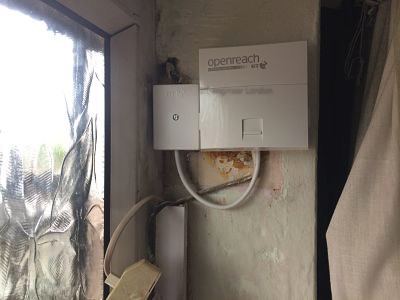
Limehouse is a peculiar bit of London — Tudor pubs, converted dock warehouses, modern blocks along the basin. The mix of old buildings with very modern occupants means the data cabling requests here are often the most interesting: a Cat6a backbone retrofitted into a Grade II listed wharf, or fibre brought into a Narrow Street flat without disturbing the original brickwork. I love working here for that reason — no two jobs are the same.
The work that takes us to Limehouse is mostly the same as anywhere else: master sockets, noisy lines, broadband that doesn't match the bill, WiFi that won't reach the back room, Cat5e/Cat6 for new offices. What changes is the building — and the wiring history that comes with it.
The Limehouse patch — where the buildings tell the story
Limehouse straddles E14 and E1, with Limehouse Basin and Limehouse Cut as the geographical anchors. Narrow Street runs along the river from Limehouse Link west towards Wapping, fronted by some of the oldest surviving riverside buildings in London — Dunbar Wharf, Limekiln Wharf, Free Trade Wharf — all converted to apartments. The Basin itself is ringed by 1990s and 2000s new-builds: Mast House Terrace, Branch Road, Northey Street, Salmon Lane on the inland side. Further north, towards Commercial Road, you get the ex-LCC estates and Victorian terraces that knit Limehouse into Stepney and the rest of the East End.
Streets I'm called to regularly: Narrow Street, Three Colt Street, Salmon Lane, Commercial Road, Branch Road, Northey Street, Newport Avenue, Horseferry Road, Goodhart Place, Ratcliffe Lane, and the various blocks around Mast House Terrace and Limehouse Marina. The Limehouse Town Hall area on Commercial Road, the Town of Ramsgate / Prospect of Whitby side towards Wapping, and the residential streets either side of Burdett Road all sit comfortably inside the patch.
DLR, the Overground and getting to your door
Limehouse station is one of the rare places in London where you have the DLR and the c2c National Rail on the same platform, which makes it easy to reach from Tower Gateway, Bank, Canary Wharf and Fenchurch Street. Westferry DLR sits just to the south. Shadwell on the Overground covers the western edge. Mile End on the Central, District and Hammersmith & City lines is a short bus ride away. For driving, the Limehouse Link Tunnel gives me a quick route in from the City and Wapping; the A13 covers anything east. Parking on Narrow Street and the Basin streets is paid-bay or residents-only, and the developments around the Marina each have their own visitor arrangements — worth checking before I arrive.
Limehouse building types and the wiring inside them
- Listed riverside warehouses (Narrow Street: Dunbar Wharf, Limekiln Wharf, Free Trade Wharf, Sun Wharf). Grade II or higher in many cases. Exposed brick and timber, original cast-iron columns, polished oak floors. Cabling has to be invisible or routed through existing service voids. The master socket is usually at the building's mains entry point in a riser cupboard — internal runs go in cable tray within the existing services, never on the brickwork.
- 1990s and 2000s riverside new-build (around Limehouse Basin and Marina). Reinforced concrete walls and floors, integral services in conduit, fibre-ready in most cases. WiFi is the recurring complaint — a single router in the kitchen won't cover a three-bedroom flat with concrete walls. Wired access points on Cat6 fix it cleanly.
- Converted dock cottages (Three Colt Street, Newell Street, Ropemakers Fields). Small footprint, original Victorian brickwork, often listed. Master socket typically in a small hallway or under the stairs. Internal runs need to go through the floor void rather than chase walls.
- Ex-LCC and post-war estates (around Commercial Road, Salmon Lane, Burdett Road). Solid concrete construction. Master socket near the front door. WiFi needs help — concrete cuts signal dead, and the standard provider router is rarely enough.
- Victorian terraces (the streets between Commercial Road and Mile End Road). Two-up two-down or three-bedroom houses with overhead drop wires. Standard fare for an east London engineer: replace the master, re-terminate the extension, line cleans up.
- Modern marina-side towers (Limehouse Marina, Branch Road). FTTP-ready, ONT pre-installed. The work is usually about access-point placement and Cat6 drops between rooms.
Three jobs from the Limehouse diary
Dunbar Wharf, Narrow Street. A duplex apartment in a Grade II listed converted warehouse. The owner had moved in eighteen months earlier and the WiFi simply would not reach the bedroom — separated from the lounge by a 50cm-thick brick wall. Drilling was not an option (and not permitted). We routed Cat6 from the entry-point ONT through the existing services riser, up into the bedroom ceiling void via a small access panel that was already there, and terminated in a flush brushed-brass faceplate on the bedroom wall. A PoE-fed ceiling AP gave full 802.11ax coverage. No brickwork touched, no plaster disturbed. The owner said it was the first time the bedroom WiFi had worked since they bought the flat.
Three Colt Street, E14. A small Victorian cottage converted into a single home. The line was hissy and the broadband sync rate sat stubbornly at 18 Mbps. I traced the run from the NTE5 in the hall and found the original drop wire had been spliced halfway along its length with a chocolate block under the floorboards — probably done when the cottage was last refurbished in the 1990s. The splice had oxidised. Removed the splice, replaced the run with fresh CW1308 from the boundary point to a new NTE5C, and the sync rate rose to 64 Mbps overnight.
Limehouse Marina, E14. A small architectural practice in a third-floor unit overlooking the basin needed six Cat6 drops to a row of workstations, a wall-mounted patch panel, and two ceiling 802.11ax access points. We routed the Cat6 in the ceiling void above the suspended ceiling tiles, terminated each drop on a Cat6 keystone, and patched everything into a wall-mounted 12-port panel by the door. Fluke-certified to Cat6 channel spec, finished in a day, with a documentation pack handed over the same afternoon.
The kit I bring to Limehouse
- NTE5A and NTE5C master sockets, plus VDSL/FTTC faceplates and FTTP-compatible accessories
- CW1308 internal voice cable and screened variants for noisy environments
- Cat5e, Cat6 and Cat6a — solid and stranded, in multiple jacket colours including black for warehouse aesthetics
- Fluke DSX cable certifier with Cat6 and Cat6a channel adapters
- Krone and IDC tools, gel-filled connectors, scotchloks for outside joints
- Line tester for tip/ring, REIN, voltage drops and noise margin
- UniFi, TP-Link Omada and BT/EE access points for 802.11ax mesh and PoE-fed wired APs
- Cable rods, fibreglass and steel, for routing through riser conduits and floor voids
- Brushed-brass, brushed-steel and white faceplates for listed and modern interiors
Limehouse exchanges, FTTP rollout and what the line will do
Limehouse sits largely on the Stepney Green and Poplar exchanges. FTTP coverage in E14 has improved considerably in recent years, especially around the Basin and the Canary Wharf side. Older streets between Limehouse and Stepney are mostly on FTTC, with VDSL sync rates depending on the distance from the cabinet. ADSL is now rare — most properties have been upgraded to at least FTTC. If you're unsure what's available at your address, a quick call lets me check the Openreach database with you on the phone.
Why an ex-BT engineer for Limehouse?
Riverside and listed buildings are unforgiving. A cable that looks fine in a 1990s new-build will look terrible bolted to the inside of a Grade II warehouse wall. Knowing the BT network history of E14 — where the underground cables come up, which cabinets serve which side of Limehouse Basin, how the older buildings were re-wired in the 1990s conversions — means I can plan a job that fits the building rather than fights it. Most Limehouse jobs are about routing as much as termination, and that's where ex-BT training pays off.
The listed building rules — what's allowed, what isn't
A surprising fraction of Limehouse property is listed. The Narrow Street warehouses (Dunbar, Limekiln, Free Trade, Sun, Spencer) are Grade II or higher. Several of the dock cottages on Three Colt Street and Newell Street are listed. Even some of the smaller buildings around Ropemakers Fields carry protection. The rules I work to in any listed Limehouse property:
- No chasing into original brickwork. The brick walls of these buildings are the protected feature; drilling them changes the listing significantly.
- No surface trunking in white plastic. If anything has to be surface-run, it goes in black or galvanised steel and is routed alongside existing services so it reads as part of the building rather than an addition.
- Existing voids and conduits only. Riser cupboards, ceiling voids, behind built-in joinery, under floorboards lifted at the joist line.
- Faceplates in brushed brass or brushed steel to match the existing electrical fittings.
- Where in doubt, ask. The building manager or the leaseholder's architect will always have a view on what's permitted.
I've turned down jobs where there was no acceptable route. There's almost always an alternative, but it sometimes means more thinking and more time. Honest advice up front saves everyone trouble later.
WiFi in Limehouse — concrete, brick, and what to do about both
The riverside buildings of Limehouse are split between two extremes for WiFi: thick brick (the warehouse conversions) and reinforced concrete (the new-build flats around the Basin). Both attenuate WiFi heavily. A single router rarely covers a three-bedroom Limehouse flat properly. The standard fix is a wired access point on Cat6 at the far end of the flat from the router. For larger duplex apartments — common in the Narrow Street warehouses — two APs on a small UniFi or Omada controller give full coverage with proper roaming between them.
The 5 GHz and 6 GHz bands (802.11ax / WiFi 6E) are particularly important here because the density of WiFi networks along the river is high — every flat has its own network, plus the marina has guest WiFi, plus passing river traffic occasionally pings the area with mobile hotspots. A properly configured AP with channel planning beats anything that tries to share the 2.4 GHz band with twenty neighbours.
FTTP, FTTC and the Limehouse fibre picture
FTTP coverage in E14 around Limehouse is now substantial, particularly in the new-build developments. The Basin-side flats, the marina towers and most of the modern blocks around Branch Road and Northey Street are fibre-ready. The older conversions on Narrow Street and Three Colt Street vary — some have FTTP, some are still on FTTC. ADSL is now rare and being phased out. If you ring with your address I can usually tell you within a minute or two what's available at your specific door.
What to expect when you ring
A typical Limehouse booking starts with a phone call describing the problem. I'll ask postcode, building type, what you've tried, what your provider has said. Listed-building jobs need a bit more discussion at the start — I want to understand the constraints before I quote, so I can give you a realistic answer rather than promising work I can't actually do. Once we've agreed an approach, I'll book a time. Most Limehouse jobs are single-visit. Listed-building work occasionally needs a second visit to plan the route in detail, but that's relatively rare. I bring all the kit, cable, test gear and faceplates with me.
The Narrow Street story — and why it matters for the wiring
Narrow Street itself is a fascinating bit of London. The buildings face onto the river along a single curving street that hugs the Thames from Limehouse Basin around to Free Trade Wharf. Most of the wharfs were originally 18th and 19th-century industrial — sail-makers, rope-makers, lime kilns, timber yards — converted to residential use mainly from the 1980s onwards. The conversions were done to a very high standard by the developers of the time, but the cabling installed during those conversions is now thirty or forty years old. A lot of my Narrow Street work is replacing legacy cabling — pulled into ducts that are now hard to access, terminated on hardware that's no longer standard — with modern Cat6 that's both faster and more maintainable. Where the original ducts can still be used, I pull new cable through them rather than creating new routes. Where they can't, I find an alternative that respects the building's listed status.
Commercial work — the offices around the Basin
Limehouse Basin and the immediate hinterland house a surprising number of small businesses. Architects, design practices, financial advisors, a couple of law firms, several small tech companies — all in converted units overlooking the water. The fit-out work I do for them follows the same pattern as my other East London commercial: Cat6 drops to each desk, a small wall-mounted patch panel, two or three ceiling 802.11ax APs centrally managed. The difference here is the buildings: many of the basin-side units are in converted warehouse blocks where the existing services tray is the only practical cable route, which limits where new drops can go. Planning the layout properly at the survey stage saves rework later.
Common Limehouse problems and the standard fixes
- WiFi blackspots in three-bedroom warehouse conversions. Thick brick walls between rooms. Cat6 to a wired AP at the far end of the flat fixes it permanently.
- Damp cable joints in older boundary points. Particularly on the older Narrow Street properties where the original drop wires entered through unsealed brickwork. Re-terminating at a proper external junction box, with the line entering the building through a sealed gland, cures slow line faults.
- FTTP router in a cupboard. The developer or installer fitted the ONT in a hall cupboard with the router beside it. The cupboard is shielded and central, but everything that needs WiFi is at the other end of the flat. A short Cat6 drop to a better router location, plus a wired AP, solves it.
- Surface-trunked legacy cabling. White plastic mini-trunking along an exposed brick wall, looking incongruous in a high-end riverside flat. Re-routing the cable internally and removing the trunking is one of the most popular tidy-up jobs I do here.
- Concrete-block WiFi in modern marina towers. Reinforced concrete floors and walls. A second AP on a Cat6 drop to the far end of the flat fixes everything.
Ring 020 3633 1131. Advice freely given.