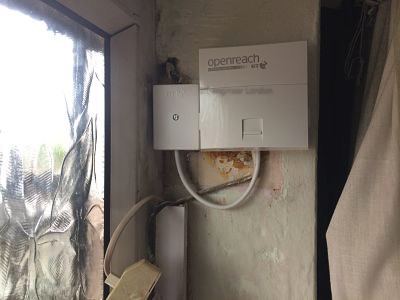
South London telephone engineer — the Thames south bank, the South Bank itself, Brixton, Camberwell, Peckham, Deptford and the patch beyond. I've been working communications jobs south of the river since I left BT in 2011, and I still find houses on every job that surprise me.
South of the river has its own character — Victorian terraces stacked along Brixton Hill, the rebuilt Elephant & Castle, the converted warehouses of Bermondsey and Deptford Creek. Each one comes with its own version of "the wiring's never been touched since 1962", and most of the time that's not far off. There's a peculiar rhythm to the patch: I can be in a Georgian sash-window flat in SE1 before lunch, then under the floorboards of an ex-LCC house in Camberwell by mid-afternoon, then up a Battersea power-station-view tower block by six. Every kind of building is here, in close range, which is why I rate working south more than people who've never tried it.
The geography of the patch — and why it matters for telephone work
People talk about "south London" as if it were one place. It isn't. The wiring story changes every couple of miles, and you can read the history of the GPO and BT in the cabling itself. South-east — Greenwich, Deptford, Lewisham, Blackheath — is full of Victorian and Edwardian housing stock that was wired for the GPO between the wars and again in the 1960s. South-central — Brixton, Stockwell, Clapham — has the same era but with a far higher proportion of converted houses, where one Victorian villa is now four flats, each with its own master socket bolted to whichever wall the previous engineer found convenient. South-west — Battersea, Wandsworth, Putney — is split between Edwardian mansion flats and the new riverside towers along Nine Elms, where the wiring is much newer but the WiFi often worse. And the south fringe — Streatham, Tooting, Norbury — is mostly interwar semis and small terraces, where the original line still comes overhead from a wooden pole on the pavement.
The Thames itself shapes the work. The cabinets and exchanges I deal with regularly are at Waterloo, Borough, Brixton, Clapham, Wandsworth, Battersea, Peckham, Camberwell, Lewisham, New Cross and Deptford. Each exchange has its own quirks, and any south London engineer who's been at it a while will tell you which cabinets are notorious for damp ingress in winter.
Transport, parking and the practical side of getting to you
I tend to plan my south-London runs around the Northern via London Bridge, the Jubilee for the riverside, the Overground for the inner-south arc (Clapham Junction through Peckham Rye to New Cross), and Thameslink for anyone south of Herne Hill. The Victoria line gets me to Brixton, Stockwell and Vauxhall in a few minutes from the centre. For the further-out jobs — Crystal Palace, Catford, Croydon — I use the car, but I avoid south-circular rush hour like the plague. Parking is the recurring headache, especially in the controlled zones around Brixton, Clapham Common and Battersea Park. If you can spare a visitor permit or let me know the bay rules when you book, the whole thing goes more smoothly.
I'll happily travel as far as Bromley, Sutton, Croydon, Mitcham, Sydenham, Beckenham, Forest Hill, Penge and Greenwich by arrangement. Honor Oak, East Dulwich, West Norwood and Tulse Hill are routine. If you're not sure whether you're in my patch, ring and ask.
Building types and what they mean for your phone, broadband and WiFi
Knowing the building tells me half the answer before I arrive. A handful of patterns I see again and again south of the river:
- Victorian terraces (Brixton, Camberwell, Peckham, Herne Hill). Master socket usually in the front bay window, original incoming line from an overhead drop wire, internal extensions often run through the cornicing or down the side of the chimney breast. Replacing the older LJU sockets with a modern NTE5C and re-terminating extensions on the customer-side faceplate fixes most of the noise complaints in one visit.
- Converted flats (Stockwell, Clapham North, Tulse Hill). Multiple master sockets in one building, one per flat, often daisy-chained off a single Openreach junction box in the hallway. The hardest part is identifying which pair belongs to which flat without disconnecting the neighbours.
- Edwardian mansion blocks (Battersea, Putney, Streatham). Long internal extension runs, frequently down service ducts. VDSL distance from the cabinet is often the limiting factor here — FTTC will give 40-something megabits, FTTP fixes it properly.
- Post-war LCC and GLC estates (Elephant & Castle, Stockwell, Deptford). Master socket can be anywhere from the front door to the kitchen. Concrete walls mean WiFi rarely makes it past two rooms without a wired access point. A Cat6 run and a ceiling AP cures it.
- Riverside new-build (Nine Elms, Battersea Power Station, Bermondsey). Usually fibre-ready (FTTP), with the ONT in a hallway cupboard. WiFi problems here are almost always about reinforced concrete floors and where the router has been installed by the developer.
- Converted warehouses (Bermondsey Street, Shad Thames, Surrey Quays). The interesting jobs. Exposed brick, exposed services, Cat6 runs needing trunked routes that don't ruin the loft aesthetic. Fluke certifiers earn their keep on jobs like these.
Three jobs from the south London diary
A few that stand out from the last couple of years — names changed, locations real.
Brixton Hill, SE24. A converted three-storey villa, four flats, and the top-floor tenant had been told by her broadband provider for six months that "the line is fine — it must be your router". I arrived to find the top-flat extension wired in solid-core bell wire, twisted around a radiator pipe, terminated in an old LJU2/1A on the skirting. From the NTE5 in the ground-floor hall, that was about thirty-five metres of unscreened cable running past two showers and a fuse-box. Replaced the run with proper twisted-pair, fitted an NTE5C with a VDSL faceplate, and her sync rate went from 19 Mbps to 64 Mbps on the same FTTC profile. Same line, same provider, same exchange — different wiring.
Camberwell New Road, SE5. Edwardian ground-floor flat with the master socket in a coal cupboard under the front steps. Damp had got into the joint and the line had developed a slow leak — fine in summer, dreadful after rain. The previous tenant had "fixed" it by adding a second master socket inside the lounge and bridging the two with a Y-splitter. I traced the original drop, re-terminated at the boundary point on the outside wall, ran a fresh CW1308 in conduit to a new NTE5C in the lounge, and abandoned the cupboard altogether. The line has been quiet ever since.
Surrey Quays, SE16. A small architect's practice in a converted dock-side warehouse needed eight Cat6 runs and two ceiling-mount access points across an open-plan floor with exposed brick walls and a polished concrete floor. There was nowhere to chase cables, so we ran black galvanised conduit along the existing services and finished the drops behind the desks. Fluke certified to Cat6 channel spec, patched into a small wall-mount cabinet by the door, with a single fibre handoff from the building's riser. Two days, no mess, full 802.11ax coverage on both APs.
The kit I bring and why it matters
I drive a small van with what I need for the vast majority of jobs already in it, including:
- NTE5A and NTE5C master sockets, plus VDSL/FTTC faceplates and FTTP-compatible accessories
- CW1308 and CW1109 internal cable, both 2-pair and 4-pair
- Cat5e, Cat6 and Cat6a in solid and stranded
- Punch-down tools, krone tools, IDC blades, gel-filled scotchloks for outside joints
- A Fluke DSX cable certifier for any data work that needs to be signed off
- A line-tester for tip/ring, REIN, voltage drops and noise margin
- UniFi, TP-Link Omada and BT/EE access points for mesh and wired AP installs
- Cable rods, fibreglass and steel, for getting through the difficult voids
South London exchanges and what they tell me before I arrive
If you can tell me the postcode and roughly which exchange you're on, I can normally predict the line type. SE1, SE11 and SE17 mostly route through Waterloo or Walworth — short loop, generally good FTTC, increasing FTTP coverage. SW9 and SW2 sit on Brixton — loop lengths vary wildly depending on which side of the hill you live on. SE15 and SE22 are Peckham — newer cabinets, decent VDSL, FTTP rolling out steadily. SE8 and SE14 are Deptford and New Cross — older infrastructure, lots of overhead drops, some streets still single-pair to the property.
Why ex-BT matters here
I trained inside BT and worked on the Openreach side before going independent. That means I know how the underground network is built south of the river, where the joints are, which manholes connect to which DPs, and how to talk to Openreach when a fault sits on their side rather than yours. Most of my customers have already been round the houses with their provider's call-centre script — "have you restarted the router?" — before they ring me. A proper engineer with a Fluke and a test set finds the actual fault in fifteen minutes.
FTTC, FTTP and what the future looks like south of the river
South London's broadband picture has shifted faster than people realise. The original ADSL roll-out from the early 2000s is now essentially history — almost every property in the patch is on FTTC at minimum, and FTTP coverage has expanded enormously since 2020. The riverside stretch from Vauxhall through Nine Elms, Battersea Power Station, Bermondsey, Rotherhithe and Surrey Quays is now overwhelmingly fibre-to-the-premises. Inner south streets in SE1, SE11, SE17, SE15, SE16, SW8 and SW11 have seen substantial FTTP build-out, with much of the rest of the inner south on FTTC at speeds that often beat what households actually need. The outer south — Streatham, Tooting, Norbury, Penge, Sydenham — is steadily catching up, with new FTTP cabinets appearing month by month.
The interesting thing is what the cable type changes about my work. With an FTTC line, the master socket and the internal extension cabling still matter — every metre of bad cable inside the house drops your sync rate. With FTTP, the master socket is gone entirely; the ONT (Optical Network Terminator) sits where the master used to be, and the customer's connection is via ethernet from the ONT to their router. That changes the job. Instead of chasing line faults, the work is about ethernet routing and WiFi coverage. Both are skills that ex-BT engineers like me have been doing for years on commercial jobs — FTTP just brings the same techniques into the home.
WiFi south of the river — why it goes wrong and how I fix it
The single most common call I get from south London households is "the WiFi doesn't reach the back room". Almost always it comes down to one of three causes:
- Router placement. The ISP installs the router wherever the master socket happens to be. That's usually the hallway, the front room or a cupboard. None of those are good central locations. Moving the router — or providing a wired drop to a better location — fixes most coverage complaints on its own.
- Building construction. Solid Victorian walls, concrete LCC/GLC walls, and reinforced concrete in modern towers all eat WiFi. A single router cannot punch through three internal walls. The right answer is a wired access point on the other side of the obstacle, not a repeater.
- Channel congestion. Inner south London has enormous WiFi density. In a converted house with four flats, you might see twenty neighbouring networks on the 2.4 GHz band. Moving to 5 GHz and 6 GHz (802.11ax / WiFi 6E) on a properly configured AP makes an immediate difference.
A typical residential WiFi job runs from a wireless survey (I bring a small spectrum analyser to look at what's already on the air) through to placing one or two PoE-fed access points on Cat6 runs from a central location. Most homes don't need mesh — a wired AP in the right place does the same job more reliably, with no halving of throughput at each hop.
What to expect when you ring
A typical south London booking goes something like this. You ring with a problem — "the line is hissy", "the broadband is slower than the bill says", "the WiFi doesn't reach the kitchen", "we need Cat6 to a new office in the garden". I'll ask a handful of clarifying questions: postcode, what kind of building, how long the problem has been there, what your provider has said. From that I can usually tell you within five minutes whether it sounds like an inside-the-property fault, an Openreach-side fault, or a kit problem with the router itself. If it's something I can fix, I'll book a time that suits you. South of the river I can usually get to you within a day or two, sometimes the same day for emergencies. Most jobs are done in a single visit — I bring everything I need with me.
Ring 020 3633 1131. Advice freely given.