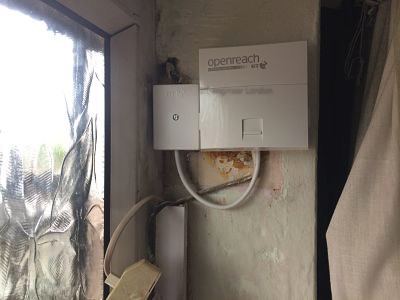
W1 is the prestige central postcode — Mayfair, Marylebone, Fitzrovia, Soho — where commercial offices, retail, hospitality and residential all sit on top of each other in the same Georgian and Victorian buildings. The work I do here is mostly commercial and small-office, mostly out-of-hours, and the finish has to be the kind you would not notice unless you were looking. Period-sympathetic routing, discreet faceplates, and a tidy comms cupboard at the end of it.
I have been the call-out engineer for W1 since 2011 — ex-BT trained, my own kit, my own Fluke certifier, and I work to a standard the building managers in this part of central London expect. Most of my W1 jobs are for offices above shops, restaurants, private members' clubs, professional services firms, and the residential flats that occupy the upper floors of buildings whose ground floors are retail. Working in this postcode means working around tenants, building staff and listed-building constraints, and almost always means working evenings, weekends or before opening.
Mayfair — offices above shops, period-sensitive routing
Mayfair properties south of Oxford Street, between Park Lane and Regent Street, are mostly Grade II listed or sit inside a conservation area. The buildings have shop or restaurant on the ground floor and office or residential above, and the wiring has been added across forty years of phone, fax, ISDN, ADSL, leased line, VDSL and now FTTP. The lead-ins enter from the building's communal riser, which often sits in a basement or under-stairs cupboard the customer has never opened.
I had a job on a side street off Berkeley Square for a small private bank that occupied the second floor of a 1740s townhouse. They had been quoted by their incumbent IT firm for a complete rip-and-replace of their cabling. When I got in there, the actual problem was a single bad patch lead in their basement comms cupboard and an unmanaged switch that had been failing intermittently for months. I ran Fluke certifier tests on every desk drop, replaced the four cables that came back bad, swapped the switch for a managed PoE unit sized for their phones and APs, and gave them a printed report. Job done in an evening and a Saturday morning. The point being: in W1 the assumption is always that the building's wiring needs replacing — half the time it just needs someone competent to test what is there.
Marylebone — residential flats and small consultancies
Up around Marylebone High Street, Wimpole Street, Harley Street and the streets off Marylebone Lane, the building stock is a mix of medical consulting rooms, residential mansion blocks, and small professional offices. The Harley Street medical practices in particular need the work done out-of-clinic-hours and they need it documented, because they are running clinical kit on their networks and they cannot have an unexplained outage.
One Harley Street consulting suite I look after took an FTTP install last year. The Openreach engineer did a perfectly good job of getting the fibre in, terminating the ONT in their basement comms cupboard and leaving a single Cat5e back to reception. Reception was fine. The two consulting rooms on the upper floors were on WiFi and the practice manager was furious because the patient management system was unusable. I ran two Cat6 drops up through an existing riser to the upper floors, terminated them into a small wall cabinet on each floor with a single ceiling-mounted 802.11ax AP each, and Fluke-certified every run. The system management software went from "barely usable" to "instant". That kind of job is typical of Marylebone — the building has the bones, the install just was not finished properly.
Fitzrovia — creative offices, studios, post-production
Fitzrovia, north of Oxford Street and west of Tottenham Court Road, is the post-production and creative-agency centre of London — Charlotte Street, Goodge Street, Rathbone Place, Newman Street, Eastcastle Street. The offices here range from single-floor agencies of fifteen people up to multi-floor production companies running serious file transfer and rendering workloads. They tend to be tenants in older buildings with structured cabling installed and replaced in waves over the years.
A typical Fitzrovia job: a small post-production house on Rathbone Place had been operating on a mix of Cat5e from a 2008 install, a couple of Cat6 drops added by their last office move, and a 1 Gbit FTTC line that was their main constraint. They migrated to a 1 Gbit FTTP service and immediately found that half their desks could not get above 200 Mbit. I tested every drop with the Fluke certifier, identified the five Cat5e runs that were the bottleneck, replaced them with new Cat6 back to their patch panel, and updated their patching to match. They got their full gigabit, signed-and-dated certifier prints went into their compliance folder, and the office did not lose a working day because I did it on a Saturday and the early hours of Sunday morning.
Soho — restaurants, bars, members' clubs, mixed use
Soho is the trickiest part of W1 to work in because the building stock is the oldest, the tenancies are the most mixed, and access is the most constrained. The streets off Old Compton Street, Dean Street, Greek Street, Frith Street, Wardour Street are full of hospitality on the ground floor and offices or flats above. Doing any kind of wiring work means coordinating with multiple tenants, the building manager, and very often a venue that is open seven days a week and only closes for a few hours overnight.
I did a job for a small members' club off Greek Street that needed a full upgrade of their staff network. The kit they were running was a domestic-grade router, an unmanaged switch sitting on top of a fridge in the kitchen, and WiFi from a single old AP behind the bar. Their card terminals were unreliable, their reservation system was unreliable, and the staff laptops kept dropping off. We did the whole job between 3am and 9am over two consecutive nights — proper Cat6 structured cabling back to a small wall cabinet in their cellar, an NTE5C and FTTC modem-router (they have not migrated to FTTP yet — Openreach's Soho rollout is patchy), a managed PoE switch, two ceiling-mounted 802.11ax APs, and a separate guest network on its own VLAN. The club did not close, did not lose a service, and did not lose a booking. That is the W1 standard.
What W1 jobs typically need
Across the whole W1 postcode, the kind of work I do most often is:
- Out-of-hours installs and changes — evenings, overnight, weekends — to keep the trading day clean.
- Cat5e and Cat6 structured cabling routed sympathetically through existing risers and voids — no surface trunking, no chases through plasterwork in listed properties.
- NTE5C master sockets fitted into discreet positions, with VDSL or G.fast filtering integrated, and the legacy bell wire stripped out.
- FTTP ONT relocations — Openreach typically land the ONT wherever is easiest, which is rarely where the customer wants the router; I extend or relocate it cleanly.
- 802.11ax (WiFi 6) access points placed by survey, on PoE, ceiling-mounted, with sensible channel planning across multi-tenant buildings.
- Patch panels, managed PoE switches, small wall cabinets, all sized to the actual load and labelled properly.
- Fluke certifier reports for every single data run, printed, signed, and handed over.
I do not do pricing over phone calls because every W1 job depends on access, hours, and how much of the existing structured cabling can be reused. What I will do, freely, is talk through the symptoms and the building with you on the phone and tell you whether you are looking at an hour of work, an evening's work, or a planned phased install over several visits. That conversation usually saves more time than it costs.
Working with building management and listed-property constraints
A lot of W1 buildings have an active building manager or managing agent, and any cabling work touching common parts (risers, comms cupboards, external lead-ins) needs to be coordinated with them. I do that coordination as part of the job — submitting risk assessments and method statements where required, working in agreed windows, signing in and out properly, and leaving the common parts as I found them. For Grade II listed and conservation-area properties, I work to the principle that nothing visible from a common part or a public-facing room should look like a 2020s telecoms install. Drilling is minimal, surface trunking is avoided, and where it absolutely has to be installed it goes in white or off-white to match the existing decor and is mitred at every corner.
Leased lines, FTTP, and the broadband choice in W1
Central London is the most over-served part of the country when it comes to broadband, and that is mostly a good thing — except that the choice of provider, network and access type is more confusing here than anywhere else. In W1 you can typically choose from Openreach FTTC and FTTP, Virgin Media business, Cityfibre via various resellers, Hyperoptic in some buildings, G.Network in many of the prestige residential blocks, and pure leased-line carriers like Colt, BT Wholesale and Zen. Each network has different physical access points in the building, each carrier has different equipment, and each install needs different handover terminations into the customer's structured cabling.
What I do, regardless of carrier, is take whatever has been delivered to the building and integrate it cleanly into the customer's network. If a 1 Gbit symmetric leased line has been handed over on a Cat6a patch into a Juniper NTU in a basement comms room, I run that cleanly up to the customer's rack on Cat6a and terminate it into their managed switch. If FTTP has been installed and the ONT is in the wrong place, I relocate it. If a building-wide G.Network deployment has terminated into a small box in a hallway cupboard, I extend it to where the customer wants the router and put proper APs in. The principle is always the same — take what the network provider has done, finish it properly, document it.
Quick wins and the value of testing
One thing I want to stress about W1 work in particular: most of the "we need a complete network overhaul" calls I take turn out to be much smaller jobs once I have actually tested the existing infrastructure. A Fluke certifier and a couple of hours will tell you which of your existing data runs are good, which are marginal, and which are failing — and very often the answer is to replace three or four bad runs, not to rip the whole installation out. I would always rather save a customer the cost of an unnecessary install than upsell them on a project they do not need. The hour or two it takes to test what is there is the most valuable thing I do, and it is the first thing I will offer to do on any W1 commercial job.
Residential work in the mansion blocks
Not all W1 work is commercial. The mansion blocks of Marylebone, the apartment buildings of Fitzrovia and the upper-floor flats above Mayfair retail are all residential properties, and most of them have a wiring story similar to anywhere else in central London — a single shared lead-in to the building, a riser carrying twisted pair or fibre to each flat, an aging NTE5A or NTE5C in the entrance hall, and a router that was last replaced when the ISP forced an upgrade. For the resident, the symptoms are universal — WiFi that does not cover the flat, broadband speed that does not match the bill, the occasional crackle on the phone if the line is still copper. The fix is the same as anywhere else: relocate the master, remove the dead bell wire, run Cat6 to a sensible router position, and put a single proper AP in the right place. Most W1 residential jobs are half a day.
Ring 020 3633 1131 — Mayfair, Marylebone, Fitzrovia or Soho. Advice freely given, day or evening.