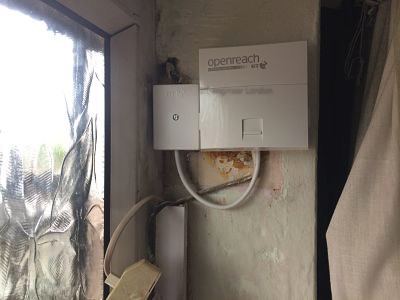
Belgravia is mostly Grade II listed — Belgrave Square, Eaton Square, Chester Square, Wilton Crescent, Lowndes Square, the white stucco terraces that Thomas Cubitt built in the 1820s and 30s and that the Grosvenor Estate still keeps to its own exacting standard. Every job in this postcode has to be done as if the building inspector and the Estate's surveyor might both walk in tomorrow. Cabling routed up redundant flue chases, NTE5C masters fitted into period-correct mounts, no surface trunking anywhere, no drilling visible from any reception room. The kind of finish that takes longer but lasts longer, and that the owners of these houses absolutely notice.
I have been working Belgravia and SW1 as an ex-BT engineer since 2011. The clients here range from private residences (often run by a butler or house manager who is my actual point of contact) to embassies, foundations and the offices of family-investment vehicles that occupy upper floors. The work has to be invisible when finished, certifiable in writing, and coordinated with whichever building manager or estate surveyor has authority over the property. None of it is the casual "drill and crack on" approach that works in a 1990s newbuild.
The listed terraces — Eaton Square, Belgrave Square, Chester Square
The big set-pieces of Belgravia — the four-storey-plus-basement stucco terraces on the main squares — are Grade II listed individually or as part of the Belgravia Conservation Area. The Grosvenor Estate, which still holds the freehold on most of these properties, has its own consent requirements on top of the listed-building legislation. In practice this means: no chases through original plasterwork, no visible cable runs in any reception room, no surface trunking on any wall that anyone will ever see, and any drilling through original elements has to be agreed in advance.
The way to wire these buildings, and the way I do it, is to use the existing routes the building gives you — original flue chases that are no longer in service, the servants' staircase voids, redundant gas pipe runs, the dumbwaiter shafts that some of these houses still have. A typical Eaton Square job: a principal-floor drawing room needed two new RJ45 points and a hidden router position. We routed Cat6 down from the second-floor comms cupboard (an ex-bedroom turned into a small server room) through a disused chimney flue that ran behind the drawing-room chimneypiece, terminated into a brass-fronted floor box recessed into the parquet on either side of the fireplace, and brought the router up into the cupboard above with a long-range external antenna feeding the principal-floor reception via a discreet AP in a cornice void. Nothing visible. Fluke certifier reports for both runs. The principal saw the work after it was finished and could not see where any of it was.
Mews properties — Eaton Mews, Belgrave Mews, Kinnerton Street
The mews behind the main squares — Eaton Mews North and South, Belgrave Mews West and North, Kinnerton Street, Wilton Mews — are mostly converted coach houses, generally two or three storeys, often the staff or guest accommodation for the main terrace but increasingly owner-occupied in their own right. The wiring story here is different — the original lead-ins are short, the buildings are smaller, and the conversion work done since the 1980s has often left layers of redundant cabling behind walls and ceilings.
I did a job in a mews off Lyall Street where the client had had four different telephone engineers in over a decade, each one adding to the wiring and none of them removing what was there. The under-stairs cupboard had a dead BT76 master socket, three abandoned junction boxes, a length of redundant CW1308 cable hanging out of a hole, and the live NTE5A fitted on top of it all. The new FTTP install had landed the ONT next to this mess. I stripped the entire under-stairs back, fitted a small wall-mounted Cat6 distribution panel, terminated the FTTP ONT into a clean Cat6 run feeding the router position, kept a single NTE5C as a backup copper service connection point, and left the cupboard looking like one person had wired it carefully rather than four people having argued about it for ten years. That kind of tidying-up is half of what I do in Belgravia.
The big commercial occupiers — embassies, foundations, family offices
Belgravia has a high concentration of diplomatic and quasi-diplomatic occupiers — embassies, consulates, residences of heads of mission, foundation offices, the central London offices of major family investment vehicles. These clients need work done to a higher security standard and almost always need it documented to a written standard. Test reports, asset lists, network diagrams, signed-off Fluke certifier results.
One of my recurring clients is a foundation that occupies the upper floors of a Belgrave Square corner property. The building is shared with another tenant on the lower floors and the comms riser is in a shared cupboard. When the foundation upgraded their broadband to FTTP, the install needed to be coordinated with the other tenant's IT firm, the building's managing agent, the Grosvenor Estate's surveyor and the foundation's own facilities manager — four parties before any cabling was touched. I produced a method statement, a risk assessment, a Saturday-only work window, and a sign-off document at the end. The job itself was a clean Cat6 run from the basement comms room up through the riser into the foundation's third-floor server cupboard, with an NTE5C retained for the legacy phone line that some of the older partners still preferred to use. Everyone signed. Everyone was happy. That is the Belgravia standard.
What "period-sympathetic" actually means in practice
People hear "period-sympathetic" and assume it means putting old-style faceplates over modern kit. It does not. In a listed Belgravia property it means:
- Using existing routes — flue chases, redundant pipe runs, behind-skirting voids, beam-edge gaps in floor structures — to avoid any new chases through original plasterwork or joinery.
- Locating the master socket and any visible faceplates in positions where they were always going to be — adjacent to original fireplaces, beside historic service points, never in the middle of a feature wall.
- Using brass, bronze or painted faceplates that match the rest of the room's switches and outlets, rather than white plastic.
- Recessing floor boxes into existing parquet or stone, not surface-mounting them.
- Avoiding any surface trunking entirely — if it cannot go inside the structure, it does not go in.
- Keeping comms cupboards out of principal rooms — in basements, ex-pantries, redundant servants' staircases or top-floor cupboards.
- Documenting every run with a Fluke certifier so that the next engineer in (which might be in twenty years) does not have to guess what is in the walls.
Belgravia services in summary
What I actually install and fix across the postcode:
- NTE5C master sockets fitted into period-correct mounts and locations, replacing older NTE5A or BT76 fittings.
- Noisy line and crackling-phone diagnosis, with full removal of redundant bell wiring and dead extensions that drag down VDSL performance.
- FTTP relocations — moving the ONT to a sensible position and running Cat6 to the actual router location, neatly and invisibly.
- Cat6 and Cat6a structured cabling between reception rooms, study, principal bedroom, comms cupboard, all certified.
- Discreet WiFi 6 / 802.11ax access points placed by site survey, ceiling-mounted in cornice voids or recessed where rooms allow, PoE-powered from a central switch.
- Comms cupboard rationalisation — taking the accumulated mess of fifteen years of bolt-on work and replacing it with a single clean small wall cabinet, properly labelled.
- Coordination with house managers, building surveyors and the Grosvenor Estate where consent is required.
Calling out — what helps me help you
If you are in SW1X or SW1W and you need work done, a brief phone call usually tells me everything I need to know to schedule properly. Things that help:
- The address (street and number — postcode alone is not enough in this part of London because the Estate's permissions vary by terrace).
- Whether the property is listed, in a conservation area, or both (in Belgravia, almost certainly both).
- Whether you have a house manager, building manager or managing agent I will need to coordinate with.
- Your current service — FTTC, FTTP, leased line — and your provider.
- Whether the work has been discussed with the Grosvenor Estate or any listed-buildings officer yet, or whether I am picking that up.
I do not push for site visits I do not need to do. If the answer to your problem is a phone call to your ISP, I will tell you that. Where I add value is in the actual wiring work — and in this postcode, in particular, in doing it to a standard that does not embarrass the building.
Multi-line residences and the second-line problem
Many of the larger Belgravia houses still keep multiple telephone lines for legitimate reasons — a household number, a separate line for the principal's office or study, a dedicated line for the staff areas, and sometimes a security or alarm-system line that has to be a copper PSTN service rather than a digital voice line over the broadband. Managing these on a single building is more complex than it looks. The lead-ins all need to come into the same demarcation cupboard, the master sockets need to be labelled clearly so the next engineer can tell which is which, and the migration to FTTP and digital voice has to be planned line-by-line rather than as a single switchover.
I have worked with a number of Belgravia properties through the digital voice migration, and the pattern is usually similar — keep the alarm and lift lines on copper for as long as Openreach will let us, migrate the household and office lines to digital voice over the FTTP service, and use a small ATA (analog telephone adaptor) to keep the existing in-house phone wiring live so that the original wall sockets in every room still work as before. That kind of careful migration takes more planning than the one-size-fits-all migration that BT's general process applies, and it is the kind of work where having a specific engineer who knows the building helps.
WiFi without visible kit — the discreet AP problem
WiFi coverage in a four-storey-plus-basement Belgravia terrace cannot be achieved with a single router sitting on a sideboard in the entrance hallway. It needs multiple access points, properly placed, ideally ceiling-mounted, hardwired back to a central switch on Cat6 with PoE. The challenge is doing it without any of the access points being visible in any of the principal rooms — which is a genuine constraint in a house where the drawing room ceiling has original 1830s plasterwork and a Robert Adam-style cornice.
The trick I use most often is to mount the AP on the ceiling of an adjacent room (typically a corridor or a service area) and rely on the AP's signal pattern to cover the principal room through the wall, rather than mounting an AP visibly in the principal room itself. With careful site surveying — I walk the building with a spectrum analyser and a tablet to measure actual coverage — it is almost always possible to find a placement that covers the room without any visible kit in it. For very large reception rooms where signal through an internal wall will not carry, I use recessed APs that fit into a small ceiling void with only a flat plastic disc visible at the surface, which can then be painted to match the ceiling and effectively disappears. It is fiddlier than a normal AP install, but it is the standard the principal in this kind of property is entitled to expect.
Working hours, access and discretion
Most Belgravia jobs happen during the working day, with the house manager or a member of the household staff on site, and the principal often not in residence at all. The work is scheduled around the household's other contractors, and access is coordinated through whoever runs the property. Discretion is part of the job — I do not discuss who I am working for, I do not photograph the property other than for technical record-keeping purposes that stay on my own kit, and I do not bring anyone onto site who has not been cleared in advance. That is the unspoken contract of working in this part of London and I take it seriously. Every Belgravia job I have done in the last fifteen years has come back from the same handful of referring estate agents, surveyors and house managers, and that is only because I treat the work and the property with the appropriate care every time.
Ring 020 3633 1131. Advice freely given.