Kensington stretches from the museums on Exhibition Road, down through Earl's Court, west to Holland Park and north to the edge of Notting Hill. The building stock is some of the best in London — Italianate stucco terraces, red-brick Queen Anne mansion blocks, the great late-Victorian houses on Kensington Palace Gardens, the artists' studios around Melbury Road and the converted apartment blocks of Earl's Court. The clientele is serious — major embassies, consulates, foundations, private residences — and broadband-spec installs here are expected to be done to a documented, certified standard. I use Fluke certifiers, I supply written test reports, and I work in the way the surveyors and managing agents in this part of London expect.
I am an ex-BT engineer covering the whole SW7, W8, W11 and SW5 area, and I have been doing it since 2011. The work in Kensington runs across three distinct types of property — the period mansions in single-family use, the mansion-block conversions where each flat needs its own treatment, and the diplomatic and commercial occupiers around the consulate quarter. Each type has its own rhythm, its own consent process, and its own standard of finish, and the engineer who turns up has to be able to read which one they are in within ninety seconds of walking through the door.
The museums quarter and Exhibition Road — SW7
Walk south from Hyde Park down Exhibition Road and you are in the museums quarter — the V&A, the Science Museum, the Natural History Museum, Imperial College — and the streets fanning out behind them are largely 1860s to 1880s Italianate terraces and the great mansion blocks of Queen's Gate, Cromwell Road and Onslow Square. Many of these properties have been converted into flats at various points over the last hundred years, and the wiring history is layered accordingly. The most common job I get in SW7 is rationalising what has been added to a flat over four or five tenancies' worth of telephone and broadband installs.
I had a job on Queen's Gate in a third-floor flat where the resident had given up trying to understand why his FTTP service was getting 200 Mbit when his neighbour in the next-door flat was getting 900 Mbit on the same package. When I tested the runs, the developer-fitted Cat6 patches in the flat's hallway distribution box had been disturbed at some point — probably during a previous refurb — and one of them had been re-terminated with a Cat5e jack. Replacing the jack with a proper Cat6 module and re-running the certifier brought the run up to specification, and the speed went where it should have been. Forty-five minutes of work, but it needed a certifier to find. Nobody without one was going to identify which segment of the chain was the bottleneck.
The diplomatic quarter and Kensington Palace Gardens
Some of the largest private and diplomatic residences in London are along Kensington Palace Gardens and the streets immediately south of Kensington Gardens — Palace Gate, Hyde Park Gate, Kensington Court, De Vere Gardens. These are large houses (often 8 to 15,000 square feet), almost always Grade II or II* listed, and almost always with a serious facilities team or family office managing the property. Work here is coordinated with the surveyor, the facilities manager, security, and very often the principal's private staff.
I work for one such residence as a recurring consulting engineer — they have an in-house IT manager who handles the network day-to-day, but when something physical needs to happen to the structured cabling, I am their call. The house has a basement comms room with a full rack of equipment, Cat6a riser cables to every floor, RJ45 floor boxes recessed into parquet in every reception room, and 802.11ax APs distributed across the building on PoE. Every run is Fluke-certified, every patch is labelled, every move is documented. When the principal upgraded their broadband to a leased line in addition to their FTTP service, my job was to terminate the leased-line handover at the basement, run a Cat6a up to the rack, configure the failover, and document the result. It went in over a weekend without disturbing the household and the test reports went straight to their facilities folder. That is the standard expected in this part of Kensington.
Earl's Court — SW5 — mansion blocks and conversions
Earl's Court has a different feel — the late-Victorian and Edwardian mansion blocks of Earl's Court Square, Bramham Gardens, Trebovir Road, Penywern Road. Most of these are leasehold flats and most of them are tenanted or owner-occupied in roughly equal measure. The wiring history is different again — usually a single 1980s lead-in into the building's basement, a CW1308 trunk up the riser, and an NTE5A in each flat that has been added to or modified by everyone who has ever lived there.
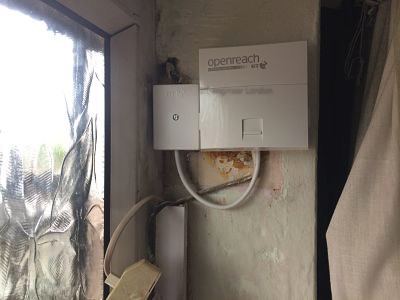
A typical SW5 job: a flat on Trebovir Road had been performing badly on a VDSL line for years, with the resident assuming the cabinet was too far away. When I went in, the NTE5A was in the kitchen above a worktop, fed by a junction box in the hallway that itself was fed by another junction box behind a bookshelf, with bell wire all over it. I removed all three junction boxes, ran a single new CW1308 from the building's incoming point in the basement up the riser (with the freeholder's permission — coordinated by the managing agent) and terminated it directly into an NTE5C in the hallway. Their VDSL sync rate went from 28 Mbit to 71 Mbit. Same line, same cabinet, same provider — just twenty years of accumulated junction-box rubbish removed. Worth saying that a lot of Earl's Court flats are still on copper and have not had FTTP arrive yet; tuning the existing VDSL is often the only thing that can be done until Openreach get to that block.
Holland Park, Melbury Road and the artists' studios
The streets north and west of Kensington High Street — Holland Park itself, Melbury Road, Addison Road, Aubrey Walk, Campden Hill — have an unusual mix of building types. The Holland Park mansions, the artists' studio houses built in the 1860s and 70s for painters like Frederic Leighton, and the more conventional Victorian and Edwardian terraces behind them. The studio houses in particular are odd to wire — double-height north-facing studios, complicated floor plans, original features that absolutely must not be touched.
I did a job in one of the Melbury Road studio houses where the owner wanted hardwired ethernet to the studio space — a 6m-high north-lit room — for video conferencing and serious file uploads. The challenge was getting the cable up there without visible runs across the original stucco walls or chases through original cornicework. We routed Cat6a up an existing service void beside the chimneystack, brought it out into a discreet floor box recessed into the studio's parquet under a piece of furniture, and installed a small 802.11ax AP in a recessed position in the ceiling void that gave WiFi coverage to the whole studio level. Fluke certifier reports, signed off, no visible change to the room. The owner — who had been worried about the work for weeks — was relieved when I left and they could not see where any of it had been done.
What serious Kensington installs need
The work I do across Kensington tends to be on the more substantial end — not because every job is enormous, but because the standard of finish and documentation expected is consistently high. Typical components of a serious Kensington install:
- Cat6 or Cat6a structured cabling, Fluke certifier tested, with printed and signed test reports for every run.
- A small wall-mounted comms cabinet (typically 9U or 12U) in a basement, plant room or service cupboard, properly cooled and labelled.
- A managed PoE switch sized appropriately for the access points, IP phones and any other PoE devices.
- 802.11ax (WiFi 6) ceiling-mounted access points, placed by site survey, with proper channel planning and roaming configuration.
- An NTE5C master socket for the legacy copper line if one is being retained, fitted into a discreet location with integrated filtering.
- The FTTP ONT in a sensible position with clean Cat6 from the ONT to the router, not the developer's default routing.
- Where a leased line is in use, a clean handover from the carrier's NTU into the structured cabling backbone, with the failover logic documented.
- Labelling, network diagrams, and as-built drawings handed over to the customer's facilities or IT manager.
How I work with managing agents and surveyors
Almost every Kensington property — listed or not — has either a managing agent, a building surveyor, or a private facilities manager who I will need to coordinate with. I produce method statements and risk assessments where they are needed, I work in agreed windows, and I leave the common parts of buildings as I found them. For embassies and consulates I work with their own facilities and security teams to whatever security protocol they require, including controlled access and supervised work where that is the rule.
I do not give pricing on the phone because every Kensington job is different — what I will give freely is a description of what I think the work involves, what the test gear will tell us, and how long I think it will take. That conversation alone is often enough for a customer to know what to do next, whether they end up booking me or sorting it themselves.
What to know before you ring
To make the first phone call useful, it helps if you have to hand:
- The address and postcode — and whether the property is listed or in a conservation area (in W8 and SW7, almost certainly yes).
- Whether there is a managing agent or facilities manager I should liaise with.
- Your current ISP and service type — FTTC, FTTP, leased line, or a building-wide deal.
- What is actually wrong, in plain English — phone, broadband, WiFi, hardwired ethernet, or a planned new install.
- Whether any work has been done to the cabling recently, and by whom, so I know whether to expect a tidy installation or fifteen years of accumulated patchwork.
The Notting Hill edge — Ladbroke Grove, Pembridge, Westbourne Grove
Although it sits on the technical boundary between Kensington and Notting Hill, I take a fair number of calls from the streets around Ladbroke Grove, Pembridge Square, Pembridge Villas and Westbourne Grove that fall within my Kensington patch. These are large stucco terraces, mostly four storeys plus a basement, mostly owner-occupied single-family or split into upper and lower maisonettes. The wiring history is similar to the rest of W11 — added in layers, never fully rationalised, often with redundant cable runs in the walls that nobody has documented.
A typical job on these streets is a comms-cupboard rationalisation combined with a new FTTP install. The customer has just had Openreach in, the ONT has been fitted in a basement cupboard, and they want me to take the rest of the under-stairs and basement clutter and turn it into a single tidy installation that will support a hardwired Cat6 backbone to every floor and ceiling-mounted 802.11ax APs in the principal rooms. That kind of job is typically a two-day install with planning ahead — a survey day to walk the building and design the routing, then a day on site to do the cabling and termination, with the certifier reports written up afterwards.
Calling and the next step
If you are in W8, SW7, W11 or SW5 and you have anything from a noisy line to a full structured-cabling install in mind, the first step is a phone call. I will ask you about the building, the service, the symptoms, and any constraints (listed building, managing agent, security protocol). From that conversation I can almost always tell you what is needed, how long it will take, and when I can come out. The Kensington work I do is rarely urgent in the same way that a fault in a small business might be urgent — it tends to be planned, scheduled around the household or the building's other works, and done properly to a standard the property deserves.
Ring 020 3633 1131. Advice freely given.