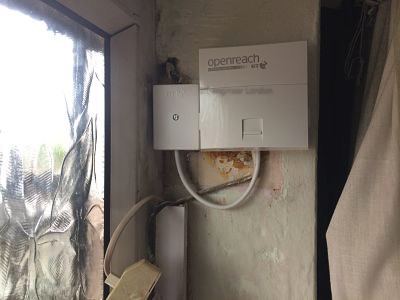
East London telephone engineer — ready to provide a prompt, quality service to business and residential customers from West Ham to Wapping, Stepney to Hainault. Real test kit, real workmanship, and the patience to look behind every faceplate before declaring a fault.
I've been working as an independent telephone engineer across east London since 2011 — started at BT, kept the certifier and the toolbag, and never stopped picking up the phone for jobs that the big providers can't or won't handle promptly. If BT's call centre can't help you, or the Openreach slot you've been given is three weeks away, that's typically when my phone rings.
Living and working in east London — the geography
East London is enormous and it isn't one thing. The patch I cover starts at the City fringe — Aldgate, Liverpool Street, the EC2 and EC3 borders — and runs out through Tower Hamlets, Newham, Hackney's eastern wards, Waltham Forest and into the redrawn edges of Redbridge. From Wapping and Limehouse along the river, through Whitechapel and Bethnal Green, up via Bow and Stratford to Leyton, Leytonstone, Wanstead, and on out to Hainault and Chigwell where the postcodes blur into Essex.
The transport map tells you a lot about how I plan a day. The Elizabeth line — what we still half-call Crossrail — cuts through Whitechapel, Canary Wharf, Custom House and Stratford. The Central line runs the spine from Bank out to Leytonstone and Hainault. The District and Hammersmith & City pick up the southern edge through Mile End, Bow Road, West Ham and beyond. The Jubilee threads Canary Wharf and Canning Town. The DLR webs the riverside from Tower Gateway through Limehouse, Westferry, Poplar and Canning Town out to London City Airport and on to Woolwich.
On four wheels it's the A12 and the A13 — Bow Roundabout, the Blackwall Tunnel approach, the Newham Way — and the North Circular along the top edge. Realistically though, much of my actual movement happens on side streets in a van that knows the difference between an E1 bollarded estate road and an E14 service alley.
The building types you find — and what they mean for your wiring
East London is, more than anywhere else in the capital, a layer cake of building eras stacked on top of each other. Within a single street you can find a Georgian merchant's house, a Victorian two-up two-down, a 1950s LCC slab block, a 1970s deck-access estate, and a 2018 glass-clad new-build. Each of them carries a different telephone story.
Victorian terraces — Bethnal Green, Bow, Forest Gate, Leytonstone
Solid brick walls, lath-and-plaster ceilings, original sash windows if you're lucky. Telephone cables typically arrived overhead from a pole during the post-war push and were run in along the front gable and down to a master socket somewhere arbitrary inside. Lots of these properties have been converted into upper and lower maisonettes, often with a single master serving the lower flat and a tangled extension wandering up to the upper. Bell-wire extensions on the skirting boards are everywhere. Drilling for new Cat5e runs needs care — old terraces have surprising amounts of solid mortar and the joist directions aren't always what you'd expect.
Georgian and early-Victorian conversions — Wapping, Limehouse, Bow Road
Smaller numbers but disproportionately interesting. Tall ceilings, deep architraves, often Grade II-listed elements meaning surface trunking is a non-starter and any cable run has to be genuinely hidden. The masters are frequently in the wrong place because the buildings have been reconfigured internally several times. These jobs reward patience and a long drill bit.
Ex-LCC and post-war ex-council blocks — Stepney, Bow, Poplar, parts of Hackney
Solid concrete construction, often with cabling that arrived through a riser cupboard somewhere on the landing. The masters live in unhelpful places — by the front door, behind a kitchen cupboard, in a hallway with no power socket near it. The challenge is usually getting any cable at all from where the line lands to where the customer wants the router, often without being allowed to chase walls. A neat surface-trunk run along a coving, or a discreet Cat5e in a corner of the skirting, is what these jobs ask for.
Warehouse conversions — Wapping, Limehouse, Shoreditch fringe
Exposed brick, exposed steel, polished concrete floors, no plasterboard to hide anything behind. The telephone install often lives in a riser cupboard shared between flats, with a long extension running around the perimeter to wherever the master was placed. These properties typically have terrible WiFi to start with — open-plan with brick internal walls and high ceilings — and they reward proper site surveys with a heat-map rather than a guess.
New-build flats — Stratford, Canary Wharf, Royal Docks, Canning Town
Master socket in a hallway data cupboard, structured Cat5e or Cat6 already run to bedroom and living-room sockets, an FTTP ONT mounted on a wall. The wiring is usually fine; the problems are around the edges — the developer's hardware is the cheapest the spec allowed, the WiFi router has been put in the cupboard with the metal door, and the structured cabling has been wired to the wrong patch panel ports. These are quick wins on a competent engineer's visit.
Suburban interwar semis — Wanstead, Snaresbrook, Hainault, parts of Chigwell
The 1930s housing belt along the Central line. Cavity brick, hipped tile roofs, decent loft access. Telephone cables typically overhead from a pole in the back gardens. Cable runs through the loft are the cleanest way to reach a back bedroom from a hallway master. These properties also tend to be far enough from the cabinet that VDSL sync rates matter — every metre of dodgy extension wire costs visible megabits.
The wiring history that matters here
East London was an early adopter of FTTC because of the regeneration push around the Olympic site and Canary Wharf. That means a lot of east London cabinets were enabled for VDSL before the rest of the city, which means a lot of east London homes had broadband filters and faceplates fitted ten or twelve years ago that are now overdue for replacement. The NTE5A is widespread; the NTE5C is starting to appear with FTTP migration jobs.
FTTP rollout in east London is, in early 2026, well advanced — the Tower Hamlets and Newham footprints are largely covered, Hackney is close behind, Waltham Forest is patchier, and the outer Redbridge edge is still mostly FTTC. When I attend a job I always ask what the line's future looks like — there's no point fitting kit today that has to come out next quarter.
Three real east London jobs — what they actually looked like
Wapping — a converted warehouse with a hidden router cupboard
Customer near Wapping High Street, two-bedroom flat in a converted warehouse, the kind with twenty-foot ceilings and exposed cast-iron columns. Broadband sync was less than half what the cabinet should have been delivering and the WiFi reached about three metres. The master socket was a junction faceplate fitted to a brick wall in a tiny utility cupboard, with the router living inside the cupboard behind a metal door because the architect had decided that was where the data point would live.
The fix was a new NTE5C in the same cupboard with a proper VDSL filtered faceplate, a short Cat5e patch up to a wall-mounted access point on the living-room side of the brick partition, and a second AP on the bedroom side. Sync climbed back to expected, WiFi reached every corner, and the customer was finally able to take video calls from the kitchen island.
Leytonstone — Victorian terrace, three generations of extensions
A two-up two-down near Leytonstone High Road, recently bought, recently being renovated. The master socket was a 4/1A junction box in the cellar — original 1980s install — and three separate extension legs ran upstairs to bedrooms that the new owners weren't using as bedrooms anymore. The line had developed a persistent crackle and the ISP had told them, predictably, that it was internal wiring.
I dropped a new NTE5C in the front hallway near the consumer unit, capped off the three redundant extensions, and ran a single Cat5e up through a discreet chase to the back bedroom where the home office was going. Tested clean on the Fluke, sync improved on FTTC, and the crackle disappeared the moment the corroded cellar extension came out of the circuit.
Stratford — a new-build flat with a router in the wrong place
A flat near Stratford International, two years old, FTTP from day one with a developer-supplied ONT in the hallway cupboard alongside the consumer unit and the boiler controls. The developer-fitted WiFi router was zip-tied to a shelf inside that cupboard and the metal door was permanently shut. Predictably the WiFi was hopeless throughout the flat. The structured cabling — Cat6 to four wall points — was all there but wired to the wrong patch panel ports.
I rebuilt the patch panel, ran a short Cat6 from the ONT through to a wall-mounted access point in the living room, repurposed the developer router as a wired switch, and verified every wall point with the Fluke. The flat went from one bar of WiFi to full coverage in an afternoon, with no holes drilled and no walls chased.
Hackney Wick — a small-business office above a unit
A design studio in an old industrial unit near Hackney Wick station, six people, two printers, a mix of laptops on WiFi and desktops on ethernet. The broadband was FTTC delivered to a master socket on the ground floor with the studio upstairs, and the extension wiring had been done by whoever last rented the space. Sync was poor, intermittent dropouts. We ran a fresh Cat6 from the master up to a small data cabinet upstairs, fitted a VDSL faceplate at the master so the extension wasn't loading the line, and added two ceiling-mount access points. The line was waiting on a scheduled FTTP install three months later, so we sized the cabinet to take an ONT when it landed.
FTTP, FTTC and the migration timeline
East London's FTTP rollout is, in 2026, ahead of most of the capital. The Olympic regeneration footprint, Canary Wharf and the Royal Docks were among the earliest fibre-rich areas, and the rest of Tower Hamlets and Newham have caught up steadily over the last few years. Hackney's eastern wards — Hackney Wick, Homerton, parts of Dalston — are mostly enabled. Waltham Forest, particularly the Walthamstow and Leyton areas, is mid-rollout. The outer fringe through Redbridge and into the Essex border is still predominantly FTTC for now.
What that means in practice: when I quote for a master socket move or a faceplate change in east London, the first question I ask is "what's the line on now and what's it moving to?" An NTE5C makes more sense than an NTE5A almost everywhere here now, because the same body accepts a fibre faceplate when the migration happens. Fitting an older NTE5A today and having Openreach swap it again in six weeks is wasted effort.
WiFi and the open-plan east London flat
One pattern I see across the converted-warehouse and new-build flats: open-plan living spaces with internal brick or concrete partitions and high ceilings. A single router in a hallway cupboard will not cover a flat like that, no matter how new or expensive the router is. The solution is wired access points — typically one or two ceiling-mounted or wall-mounted units running off Cat5e or Cat6 patches from the router. 802.11ax (WiFi 6) hardware is the current standard and is what I fit by default.
What I bring on the van — every job, every postcode
- Genuine NTE5A and NTE5C masters, VDSL filtered faceplates, fibre faceplates.
- Cat5e and Cat6 cable on drums, in white and grey.
- A Fluke certifier for proper test reports on data cabling.
- A butt-set, a tone generator and an insulation tester for line work.
- Wall-mountable access points capable of 802.11ax (WiFi 6).
- Patch panels, faceplates, modules, IDC tools — the boring stuff that makes the job clean.
Booking a visit
Ring 020 3633 1131 and describe the symptom — crackly line, slow broadband, dead socket, WiFi blackspot. Mention the postcode and the building type if you know it. I'll usually be able to tell you straight away whether it's a half-hour job or a half-day job, and we'll find a slot that suits you rather than the one Openreach was about to offer you in three weeks' time.
Ring 020 3633 1131. Advice freely given.