The EC1 postcode covers Clerkenwell, Farringdon, the Barbican and St Luke's — converted warehouses, Georgian terraces and post-war estates side by side. Tech startups and law firms above pubs that have been there since 1840. I work in EC1 most weeks, and it's one of the few patches of London where I can walk between three jobs in an hour without needing the van.
The work that takes us to EC1 is mostly the same as anywhere else: master sockets, noisy lines, broadband that doesn't match the bill, WiFi that won't reach the back room, Cat5e/Cat6 for new offices. What changes is the building — and the wiring history that comes with it. A Clerkenwell loft with eight floors of accreted phone cabling above it is a different proposition to a fresh fit-out on Goswell Road. Knowing which is which before I arrive is half the job.
What EC1 actually looks like, street by street
EC1 isn't one neighbourhood. It's a cluster. Clerkenwell proper runs roughly from Clerkenwell Green down to Farringdon Road, with Exmouth Market at its heart. Farringdon itself sits along Farringdon Road and Cowcross Street, with the Elizabeth line and Thameslink station as its anchor. The Barbican estate is its own world — concrete walkways above ground, lakes and gardens in the middle, a maze of service tunnels below. St Luke's is the lesser-known fourth quarter, north of Old Street roundabout, with the City Road as its spine. Add in St John's Square, Smithfield, Hatton Garden and the legal quarter around Gray's Inn Road and you have most of what I'm called to.
The streets I'm in most often: St John Street, Goswell Road, Old Street, City Road, Clerkenwell Road, Rosebery Avenue, Farringdon Road, Cowcross Street, Exmouth Market, Charterhouse Square, Charterhouse Street, Hatton Garden, Leather Lane, Whitecross Street and the Barbican's residential blocks (Cromwell, Lauderdale, Defoe, Andrewes, Shakespeare, John Trundle, Speed). If you live or work on any of those, I'll know roughly which cabinet you're on before I knock on your door.
Tube, Crossrail and getting around EC1
EC1 is one of the best-connected postcodes in London. Farringdon now has Tube, Thameslink and the Elizabeth line all in one station, which means I can be in EC1 from Paddington, Liverpool Street or Canary Wharf in twelve minutes. Barbican station serves the Circle, Hammersmith & City and Metropolitan lines. Old Street has the Northern. Angel is a short walk from the top of St John Street. Chancery Lane (Central line) covers the western edge.
For driving, EC1 is inside the Congestion Zone and the ULEZ, which I plan around. Parking is genuinely difficult: most streets are residents-only on weekdays with very limited paid bays. The Barbican has visitor bays in the underground car parks but you need to know which entrance and which level. I'll usually ask before booking what the parking situation looks like on your street.
The buildings of EC1 — and the wiring that lives inside them
- Converted warehouses and loft apartments (St John Street, Britton Street, Clerkenwell Close). Originally industrial, converted in the 1990s and 2000s. Exposed brick, exposed services, polished concrete floors. The original phone wiring was often run on the surface in white mini-trunking, which looks dated next to a polished modern fit-out. Re-running in black Cat6 along existing service routes, terminating in flush faceplates, gives a much cleaner result.
- Georgian and early Victorian terraces (Charterhouse Square, Sekforde Street, Wilmington Square). Listed in most cases. Cabling has to go through existing voids — chimney flues, behind skirting, under floorboards lifted at the joist line. Master sockets are typically tucked into a hall cupboard.
- The Barbican. A category of its own. Reinforced concrete walls and floors, integral services in conduit, Crittall windows, and a centralised cable distribution system feeding each flat. Phone cabling enters the flat at a single entry point — usually in the entrance hall — and any internal runs need to be planned around the existing conduit layout. WiFi here is almost always about access-point placement: a single PoE-fed AP on the ceiling of the central living space usually fixes everything.
- Post-war local-authority blocks (St Luke's, around Banner Street and Lever Street). Solid concrete, master socket usually near the front door, intercom and phone often sharing a riser. WiFi rarely penetrates more than two rooms — wired Cat6 to a second AP is the right answer.
- Mansion blocks (Rosebery Avenue, Gray's Inn Road). Edwardian, generous voids above the hall ceiling, but VDSL distance from the Holborn cabinet can be the limiting factor in older streets. FTTP is rolling out and worth waiting for if you're not in a hurry.
- New-build mixed-use (around Old Street and the City Road / Pear Tree Street developments). Fibre-ready, ONT pre-installed in a cupboard, mostly just a case of provisioning and getting the WiFi placement right.
- Office space above shops (Hatton Garden, Leather Lane, Exmouth Market). The hardest bit is the shared riser. Multiple BT lines stacked into a single point of entry, with the wiring layered up over thirty or forty years. Tracing whose pair is whose is where the test set earns its keep.
Three jobs from the EC1 diary
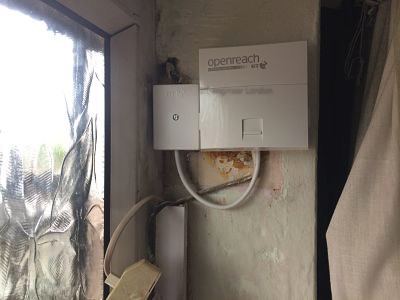
Britton Street, EC1M. A small design studio occupying the top floor of a converted print works. The previous tenant had left a tangle of surface-trunked cabling along the exposed brick wall — phone, broadband, alarm, doorbell, all in one ugly white channel. We stripped it all back, ran Cat6 in black braided sleeve along the existing service route, fitted a small wall-mounted patch panel by the door, and installed two ceiling-mount 802.11ax APs. The new master socket — an NTE5C with VDSL faceplate — sits flush in the wall by the entrance. Everything Fluke-certified, all cabling matches the building's existing aesthetic.
Lauderdale Tower, Barbican. A long-term resident on a high floor had been struggling with WiFi dead spots in the bedrooms for years. The flat had a single router in the lounge and concrete walls between rooms. We ran two Cat6 drops from the entrance-hall master socket location through the existing conduits — using the Barbican's standard wireway between rooms — and installed PoE access points on the ceilings of the master bedroom and the study. Coverage is now full-strength in every room, with no visible cabling. The whole job took half a day and the resident didn't have to move a single piece of furniture.
St John Street, EC1V. An expanding tech firm taking over a second floor of a converted warehouse. They needed twelve Cat6 drops, a wall-mounted patch panel with a small UPS, two ceiling APs and a structured cabling certification report for their landlord. We did the install over a weekend so the team could start on Monday morning. All twelve drops Fluke-certified to Cat6 channel spec, patched and labelled, with a clean documentation pack handed over by 8am Monday.
The technical kit I bring to EC1
- NTE5A and NTE5C master sockets, plus VDSL/FTTC faceplates and FTTP-compatible accessories
- CW1308 internal voice cable, plus screened variants for noisy commercial environments
- Cat5e, Cat6 and Cat6a — solid and stranded, in white, black and ivory
- A Fluke DSX cable certifier with Cat6/Cat6a channel adapters and patch-panel reporting
- Krone and IDC tools, gel-filled connectors for damp joints, scotchloks for outside joints
- Line tester for tip/ring, REIN, voltage drops and noise margin
- UniFi, TP-Link Omada and BT/EE access points for 802.11ax mesh and wired AP installs
- Cable rods (fibreglass and steel) for routing through Barbican conduits and warehouse voids
- Flush brushed-steel, brushed-brass, white and ivory faceplates for period and modern interiors
Why ex-BT matters in EC1
EC1 is layered. Every building has been wired and re-wired multiple times. Knowing which cables are GPO original, which are 1970s BT, which are 1990s converged-services and which are this year's fibre means I can leave a job with the right cables connected and the wrong ones safely abandoned. The Openreach training I did before going independent in 2011 gives me the tools to do that without guesswork. When you ring an ex-BT engineer in EC1, you're getting someone who's seen the same wiring stories enough times to fix the actual fault rather than throw new cable at it.
Commercial fit-outs in EC1 — the practical realities
A large slice of my EC1 work is commercial fit-out. The classic brief: a tech firm or law firm has just taken a floor in a converted warehouse or post-war office block, and they need structured cabling installed before they move in. The work pattern is consistent:
- Survey. Walk the floor, identify desk positions, plan riser entry, plan AP positions, work out cable routes that don't fight the existing services.
- Containment. Decide on tray, basket, conduit or surface trunking depending on the building. EC1 warehouses usually need black galvanised tray to match the existing services aesthetic.
- Cable pull. Cat6 or Cat6a from a central patch panel out to each desk drop. Solid-core for the in-wall runs, stranded for the patch leads.
- Termination. Cat6 keystones at the desk, patch panel at the cabinet. Each port labelled at both ends.
- Certification. Every drop Fluke DSX certified to Cat6 channel spec. Full report handed over with the invoice — wire-map, length, attenuation, NEXT, FEXT, return loss, all signed off.
- WiFi. PoE-fed 802.11ax APs on the ceilings, centrally managed (UniFi or Omada), with proper SSID separation and channel planning.
Most EC1 office fit-outs run over a weekend or two evenings, so the firm can be operational on Monday morning. I work to that timeline as standard.
The residential side of EC1
EC1 has more residents than people who don't work here might assume. The Barbican alone houses thousands. The Charterhouse Square mews properties, the Sekforde Street and Wilmington Square Georgian terraces, the converted-warehouse flats along St John Street and Britton Street, and the new-build apartments around Old Street and Pear Tree Street together make EC1 a genuine residential postcode. The residential calls I get tend to be:
- Master socket relocation. The existing master is in the wrong place — usually in the hall by the front door, when the household wants the router in the living room. A new NTE5C in a better location, with proper extension wiring, fixes it.
- Noisy line. Almost always an internal wiring problem — a chocolate-block splice, a corroded joint, an unscreened extension picking up REIN from a neighbouring flat. A test set finds it in fifteen minutes.
- WiFi black spots. Concrete walls in the Barbican, thick brick walls in the Georgian terraces, both block WiFi. A wired AP on a Cat6 drop cures it cleanly.
- FTTP installs. Where the building is fibre-ready but the ONT has been installed in a cupboard that's awkward for the router. A short Cat6 run to a better location is all it takes.
Working in the Barbican — what to expect
The Barbican deserves its own paragraph. Every flat has a slightly different layout, but they all share certain features: reinforced concrete walls and floors, integral conduit for services, a single phone entry point near the front door, and a centralised cable distribution from the building's plant rooms. The conduit layout is the key: cables can be re-routed within the existing conduits between rooms, but cutting new chases is generally not permitted and not advisable in any case. A typical Barbican job runs from understanding which conduit goes where, planning a route that uses only existing conduits, and terminating in flush faceplates that match the original fittings (usually ivory or white). PoE-fed APs on ceiling roses give whole-flat WiFi coverage without any visible cabling.
What to expect when you ring
Most EC1 jobs can be booked from a single phone call. Tell me the postcode, the kind of building, and the problem in plain English. I'll ask a handful of clarifying questions — what your provider has said, how long it's been an issue, what kit you've already tried. From that I can usually quote you a likely fix on the phone, and book a slot. EC1 is one of my regular patches, so I can often fit you in within a day or two, sometimes the same day for emergencies. Most jobs are done in a single visit — I bring the kit, the cable, the test gear and the faceplates with me.
Ring 020 3633 1131. Advice freely given.