Aldgate is City-fringe — finance and tech offices on one side, the residential streets of Whitechapel and Spitalfields on the other. Office work here tends to be evening or weekend (minimum-disruption); residential work tends to be the conversions and ex-council blocks that have seen ten different wiring jobs over the decades. I work the Aldgate patch most weeks, and the variety is why I keep coming back.
The work that takes us to Aldgate is mostly the same as anywhere else: master sockets, noisy lines, broadband that doesn't match the bill, WiFi that won't reach the back room, Cat5e/Cat6 for new offices. What changes is the building — and the wiring history that comes with it.
Aldgate — the City fringe up close
Aldgate sits at the eastern edge of the Square Mile, where EC3 meets E1. Aldgate Pump marks the historical boundary and is still where most people give directions from. North of Aldgate the streets run into Spitalfields and Brick Lane; east into Whitechapel; south to Tower Hill and the river. The buildings are layered in a way that's specific to this corner of London: 19th-century warehouses and merchants' houses, post-war office blocks from the 60s and 70s, the wave of City glass towers from the 1990s onwards, and now the new mixed-use developments around Aldgate Square and the Aldgate East area. Add the listed Hawksmoor churches, the Georgian terraces of Folgate Street and Princelet Street, and the ex-LCC estates south of Whitechapel High Street, and you have a working area where I can do six jobs in a week and visit six completely different building types.
Streets I'm called to regularly: Aldgate High Street, Whitechapel High Street, Middlesex Street (Petticoat Lane), Houndsditch, Mansell Street, Mitre Street, Leman Street, Goulston Street, Commercial Street, Folgate Street, Princelet Street, Wilkes Street, Brick Lane, Fashion Street, Toynbee Street, Brushfield Street, Aldgate Square, Minories, and the various streets in the Aldgate East and Whitechapel zones.
Transport, parking and ULEZ
Aldgate has Aldgate (Circle, Metropolitan), Aldgate East (District, Hammersmith & City) and Tower Hill (Circle, District) within minutes of each other, plus Liverpool Street (multiple lines, Elizabeth, mainline) a short walk to the north and Fenchurch Street to the south. The DLR at Tower Gateway covers the river side. For driving, Aldgate sits inside both the Congestion Zone and ULEZ. Parking is paid-bay or residents-only on every street I work; the underground car parks at Aldgate Square and Tower Hill are the practical options for longer jobs. For evening or weekend commercial work, the streets are quieter and finding a bay is easier — which is why so many Aldgate office jobs run after 6pm.
Building stock and the wiring story
- Glass-front City office towers (around Aldgate Square, Mansell Street, Minories). Built or refurbished from the 1990s onwards. Modern Cat6/Cat6a structured cabling from new, with patch panels in dedicated comms cupboards. Work here is usually adds, moves and changes within an existing system, or extending coverage onto a newly let floor. Fluke-certified documentation is mandatory.
- Post-war commercial blocks (Houndsditch, Leman Street). The classic Aldgate problem — buildings put up in the 60s with cabling layered on top through every subsequent tenancy. Risers full of legacy phone cabling, often abandoned. Tracing live pairs against dead ones is half the job, and a test set is the only honest way to do it.
- Listed Georgian terraces (Folgate Street, Princelet Street, Wilkes Street). Some of the oldest surviving terraced houses in London. Grade II or higher. Cabling has to be invisible, internal runs through existing voids, master sockets tucked into a small cupboard or under the stairs.
- Converted warehouses (around Brick Lane and the streets to its east). Exposed brick, exposed services. Surface trunking in modern black or galvanised — never white plastic. Cat6 runs along the existing service routes, terminated in flush faceplates.
- Ex-LCC estates (south of Whitechapel High Street, around Goulston Street and Brune Street). Concrete construction. Master socket near the front door. WiFi struggles between rooms — a wired AP cures it.
- New-build mixed-use (Aldgate Square, Goodman's Fields). FTTP from day one in most cases, ONT in a hall cupboard, the work is router placement and adding wired APs where the developer's plan didn't quite reach.
Three jobs from the Aldgate diary
Folgate Street, E1. A Grade II listed Georgian terrace converted into a private residence. The owner wanted hardwired ethernet to a study on the second floor without disturbing the original plaster, panelling or wood floors. We routed Cat6 from the master socket position in the hallway, up through an existing void by the chimney breast, under the second-floor floorboards (lifted at the joist line, replaced exactly as they were), and terminated in a small ivory faceplate at desk height. A small PoE access point in the ceiling rose finished the WiFi side. No paint scuffed, no skirting permanently moved. The owner inspected the work afterwards and couldn't see where we'd been — which is the brief in Folgate Street.
Mansell Street, EC3. A small finance firm taking a new mezzanine in a multi-tenant office building needed twelve Cat6 drops, a small wall-mounted 24-port patch panel, and two ceiling 802.11ax access points. The building's existing comms room was on the ground floor, with shared riser to the mezzanine. We ran Cat6 from the riser into a containment tray above the suspended ceiling, dropped to each desk position, terminated on Cat6 keystones, and patched into a new wall-mounted cabinet. Fluke-certified to Cat6 channel spec, finished over a Friday evening and Saturday morning, no disruption to the rest of the building.
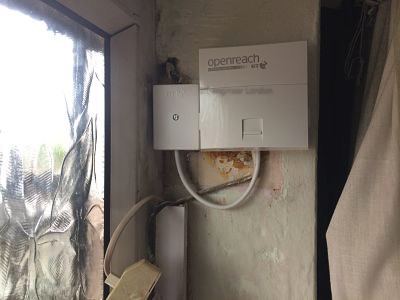
Goulston Street, E1. An ex-LCC flat in a concrete block where the line had been crackling for two years and the broadband would drop every time the kettle boiled. The previous engineer had run an extension across the kitchen ceiling in unscreened cable — directly above the kettle and toaster sockets. The REIN from the kitchen appliances was wrecking the line. I rerouted the extension through the hall, away from any high-current appliances, fitted a new NTE5C with VDSL faceplate properly grounded, and the line cleared the same afternoon. Sync rate doubled.
What I bring on an Aldgate job
- NTE5A and NTE5C master sockets, plus VDSL/FTTC faceplates and FTTP-compatible accessories
- CW1308 internal voice cable and screened variants for noisy commercial environments
- Cat5e, Cat6 and Cat6a — solid and stranded, in white, black and ivory for commercial and listed-building work
- Fluke DSX cable certifier with Cat6 and Cat6a channel adapters and patch-panel reporting
- Krone and IDC tools, gel-filled connectors, scotchloks for outside joints
- Line tester for tip/ring, REIN, voltage drops and noise margin
- UniFi, TP-Link Omada and BT/EE access points for 802.11ax mesh and PoE-fed wired APs
- Cable rods, fibreglass and steel, for routing through risers, voids and conduits
- Brushed-steel, brushed-brass, ivory and white faceplates for matching commercial and period interiors
Aldgate exchanges and what to expect from the line
EC3 and the western edge of E1 are mostly served by City and Bishopsgate exchanges, with short loop lengths and excellent VDSL/FTTC performance. FTTP rollout in the Aldgate area is now substantial, particularly in the new-build and refurbished commercial buildings. Older residential streets in E1 (Folgate Street, Princelet Street, Wilkes Street) sit on slightly longer loops but VDSL is still reliable; FTTP is available on many of them now. ADSL is rare. If you ring with your address I can usually tell you within a minute or two what's available at your specific door.
Why ex-BT matters here
Aldgate has had more cables run into and out of it than almost any postcode in London. Every office tenancy adds its own. Every conversion adds its own. By the time I'm called, the riser cupboard often contains decades of overlapping cabling, and the question is rarely "where do I add a new cable" but "which of these existing cables actually belongs to your line". Knowing how Openreach builds and labels its network, and how the older GPO and BT cabling was originally run, lets me identify the right pair quickly and leave the wrong ones safely out of circuit. Ex-BT training is essentially pattern recognition — and Aldgate is a postcode where pattern recognition saves hours of guesswork.
Commercial fit-outs in Aldgate — the practical pattern
A significant share of my Aldgate work is small-to-medium commercial — finance firms, law practices, tech start-ups, design agencies, members' clubs. The fit-out pattern is consistent:
- Survey. Walk the floor, identify desk positions and AP locations, plan riser entry, work out cable routes that play nicely with the existing services and the landlord's specification.
- Containment. Tray or basket above the suspended ceiling for most modern offices; black galvanised conduit for the converted-warehouse jobs near Brick Lane.
- Cable. Cat6 or Cat6a from a central patch panel out to each desk drop. Solid-core for the in-wall and ceiling-void runs.
- Termination. Cat6 keystones at the desk in a floor box or wall outlet; patch panel at the cabinet. Every port labelled at both ends, both physically and in the documentation.
- Certification. Every drop Fluke DSX certified to Cat6 or Cat6a channel spec. Full report — wire-map, length, attenuation, NEXT, FEXT, return loss — handed over with the invoice.
- WiFi. PoE-fed 802.11ax APs on the ceilings, centrally managed (UniFi or Omada), with proper SSID separation between staff, guest and management traffic, and channel planning to avoid the dense WiFi environment around the City fringe.
Most Aldgate office fit-outs run over a weekend or two evenings to minimise disruption. The 6pm-onwards work is standard here — the streets are quieter, parking is easier, and the firm can be operational on Monday morning.
The residential side of Aldgate
Residential Aldgate divides into three: the listed Georgian terraces of Folgate Street, Princelet Street and Wilkes Street; the converted warehouses around Brick Lane; and the ex-LCC and post-war estates south of Whitechapel High Street. Each presents different challenges:
- Listed Georgian. Invisible cable runs only. Existing voids, behind joinery, under lifted floorboards. Faceplates in ivory or brushed brass to match original fittings. No drilling of plaster, no chasing of skirting.
- Converted warehouse. Surface cable runs in black braided sleeve or galvanised tray to match exposed services. Cat6 in black jacket where it shows. Flush brushed-steel faceplates.
- Ex-LCC and post-war. Solid concrete walls and floors. Master socket near the front door. WiFi needs wired access points on Cat6 — repeaters and mesh are not enough.
FTTP coverage in EC3 and E1
FTTP rollout in the Aldgate area has been substantial. Most of the new-build and recently refurbished commercial buildings are fibre-ready or fibre-installed. Many of the listed Georgian terraces in E1 now have FTTP availability — Openreach has been working hard to bring fibre to streets like Folgate Street and Princelet Street without disturbing the historic streetscape. ADSL is largely gone. FTTC remains common in older residential blocks but is gradually being supplanted by FTTP. If you ring with your address I can usually tell you on the phone what's available at your specific door and what the line will reasonably do.
WiFi in Aldgate — what to expect
WiFi in Aldgate is a tale of two environments. In the modern offices it's generally a managed network problem — getting AP coverage right, separating SSIDs, planning channels in a dense urban environment. In the listed Georgian residences it's a wall-thickness problem — the front-to-back depth of a Folgate Street house is substantial, with thick brick party walls between rooms, and a single router rarely covers it. The standard fix is one or two PoE-fed APs on Cat6 drops, placed for whole-house coverage. In the converted warehouses it's an open-plan problem — the room sizes are large and the metalwork in the building can create unexpected reflections. A site survey with a spectrum analyser before committing to an AP layout usually saves time.
What to expect when you ring
A typical Aldgate booking starts with a phone call describing the situation. Residential or commercial, postcode, building type, what's wrong. I'll ask a handful of clarifying questions and quote a likely fix on the phone where I can. Commercial fit-outs need a site visit to survey before quoting, which I can usually do within a day or two. Residential jobs can normally be booked direct. Most Aldgate work is single-visit; complex fit-outs and listed-building installs occasionally need a second visit for planning. I bring all the kit, cable, test gear and faceplates with me.
Ring 020 3633 1131. Advice freely given.