North London telephone engineer — covering the boroughs of Islington, Hackney, Camden, Haringey, Enfield and Barnet, plus the fringes of Waltham Forest where the postcodes overlap. Residential and small-business, the same engineer for both.
I've been working as an independent communications engineer across north London since 2011 — started at BT, never lost the test kit or the habit of doing a job properly the first time. North London's the patch I know best: I can tell you which streets in N5 are still overhead-fed, which Hackney estates have shared risers, and which Enfield cabinets are running hot at peak. That kind of detail saves time on a job, and time is what you're really paying for.
The patch — boroughs, high streets, transport
The patch stretches from the Regent's Canal at the southern edge — Angel, King's Cross, Caledonian Road — up through the inner boroughs and out to the North Circular and beyond into the suburban fringe. Islington and Hackney form the heart of it; Camden runs along the western edge through Kentish Town and Tufnell Park; Haringey covers Crouch End, Hornsey, Wood Green and Tottenham; Enfield takes in Palmers Green, Southgate, Edmonton and the borough up to the M25; Barnet covers East Finchley, Finchley Central, Whetstone and on to High Barnet.
The high streets I know well: Upper Street, Essex Road, Stoke Newington Church Street, Stoke Newington High Street, Holloway Road, Kentish Town Road, Crouch End Broadway, Muswell Hill Broadway, Hornsey High Street, Green Lanes from Manor House up through Harringay to Palmers Green, Wood Green High Road, Edmonton Green, Fore Street, Southgate Circus, Enfield Town. Each one has its own pattern of building stock above the shops.
The transport network shapes how I plan a day. The Victoria line — the spine of north London — runs from King's Cross up through Highbury, Finsbury Park, Seven Sisters, Tottenham Hale and Walthamstow Central. The Piccadilly threads from King's Cross out through Caledonian Road, Holloway Road, Manor House, Wood Green, Bounds Green, Arnos Grove and on to Cockfosters. The Northern line splits at Camden Town — one branch through Kentish Town, Tufnell Park, Archway and Highgate to East Finchley and beyond; the other through Mornington Crescent and Euston. The Overground threads east-to-west across the middle through Highbury, Canonbury, Dalston, Hackney Central and on. The North London Line carries you across the top of the inner boroughs.
On four wheels it's the A1, the A10 up Stamford Hill, the A105 through Palmers Green and Winchmore Hill, the A406 North Circular along the top edge, and a thousand backstreets where the satnav is wrong and a local engineer just knows.
The building types — and what they mean for your wiring
North London's housing stock is one of the most varied in the capital. Within a five-minute walk in Canonbury you can pass a Georgian terrace, an early-Victorian villa, a converted late-Victorian school, a 1930s mansion block, a 1960s LCC slab, and a 2020 mews development. Each comes with a different wiring history.
Georgian and early-Victorian terraces — Canonbury, Barnsbury, Islington, Highbury
Tall, narrow, four floors plus a basement, often Grade II-listed. Lath-and-plaster ceilings, original cornices, period architraves you absolutely cannot disturb. Telephone cables arrived overhead from a pole in the back garden during the post-war push and were typically run in through a rear window or under the eaves to a master socket somewhere arbitrary. Chasing for new Cat5e is rarely an option — surface trunking in matched paint, or runs through cupboards and behind skirting, is the trade. The job rewards patience and a long flexible drill bit.
Victorian terraces — Stoke Newington, Tufnell Park, Crouch End, Tottenham, Wood Green
The classic two-up two-down or three-storey terrace. Solid front walls, single-skin party walls, often converted into upper and lower flats. The original master socket was typically fitted on the ground floor and a bell-wire extension was added later running up to a bedroom that nobody uses for the phone anymore. These extensions are often the cause of crackly line faults and degraded VDSL sync — disconnecting them is almost always the first move.
Edwardian semis and detached — Muswell Hill, Crouch End slopes, Highgate fringe
Bigger footprint, hipped roofs, generous loft space, often original parquet floors. The loft is your friend — clean joist runs across the top of the house make for hidden Cat6 routes that a competent engineer can deliver in half a day. Original telephone wiring often dates from the 1980s and is well overdue for replacement.
Mansion blocks — Highbury, Islington, parts of Camden
1920s and 1930s purpose-built flats, often Grade II-listed externally. Cabling typically arrives through a shared riser cupboard on each landing, with individual masters inside each flat. The risers are sometimes shared with other services, which means cable runs need to be done with care and not all routes are available. The masters often live near the front door — handy for the installer, useless for the resident who wants the router by the desk.
Ex-LCC and post-war ex-council — Edmonton, parts of Tottenham, Highbury New Park edges
Solid concrete construction, lift cores, shared services. The master usually lands in a hallway cupboard alongside the consumer unit, and chasing concrete walls is rarely viable. Surface trunking along skirtings, neatly clipped, is usually how Cat5e extensions get done in these properties. Many are now on FTTP.
Suburban interwar semis — Palmers Green, Southgate, East Finchley, Whetstone
Cavity brick, generous loft access, gardens front and back. Telephone cables typically overhead from poles in the back garden, with the dropwire attached at the eaves. Loft runs make hidden Cat6 cabling straightforward. The masters often sit in a hallway or under-stair cupboard, and moving them to a more useful location is one of the most common jobs I do out here.
New-build flats — King's Cross development, Stratford-side of Hackney, parts of Tottenham Hale
Structured Cat5e or Cat6 already run to wall points, FTTP ONT on a wall in a hallway cupboard, developer-supplied router. The wiring is usually fine; the configuration is usually wrong. The ISP-supplied router is sat inside a metal-doored cupboard, the patch panel is wired to the wrong ports, and the WiFi is hopeless three metres beyond the cupboard door. Quick wins on a single visit.
The wiring history that matters here
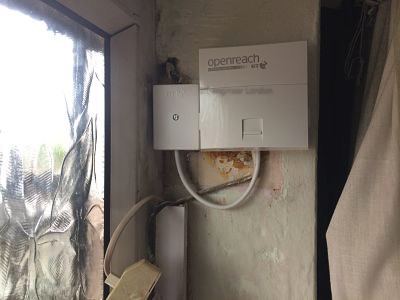
North London was a relatively early FTTC area in the inner boroughs and a later FTTC area in the outer ones. As of 2026 FTTP is widespread across Islington and Hackney, well advanced in Haringey, patchy through Enfield and Barnet, with most properties on a published rollout schedule. That timeline matters when I'm deciding what to fit on a master socket job — there's no point installing an NTE5A with a VDSL faceplate today if FTTP is landing in six weeks. An NTE5C with the right faceplate makes more sense; the same body accepts the fibre termination when the migration happens.
The thing north London has more of than anywhere else I work is dead extension wire. Houses that have been Victorian terraces, then converted to flats, then converted back, then re-converted, accumulate phone wiring layers. I routinely find two, three, four legs of extension running off a single master, most of them going nowhere useful, all of them loading the line and dragging VDSL sync down. Removing dead legs is one of the quickest wins on any north London job.
Five real north London jobs — what they actually looked like
Canonbury — a Georgian terrace and a router in a basement
A Grade II-listed Georgian terrace off Canonbury Square, four floors plus a basement. The master socket had been fitted by Openreach in the basement utility room, where the incoming cable was easiest to terminate. The family lived primarily on the ground and first floors and the WiFi from the basement-mounted router reached approximately one room. Listed interior meant no chasing, no surface trunking on any visible wall, and a careful negotiation with what could and couldn't be touched.
The fix was a new NTE5C in the basement on the existing termination, a Cat6 run up through an existing service void in a cupboard, and a wall-mounted access point on the ground-floor landing. Second access point on the second-floor landing covered the bedrooms. No visible cabling on any reception-room wall. Sync came up on FTTC because the dead extensions in the upper floors got disconnected at the same time.
Stoke Newington — a maisonette with three layers of wiring
A two-bed upper maisonette off Stoke Newington Church Street, in a Victorian terrace that had been converted twice. The master socket was on the ground floor of the downstairs flat — left over from the original house wiring — with an extension running up to the upstairs maisonette's hallway. From there a further extension wandered to a bedroom that was now a home office. Three layers of bell-wire, all corroded somewhere along the way.
The cleanest fix was a new master inside the upstairs maisonette, fed off the incoming cable at the property's external entry point and rerouted internally. New NTE5C, VDSL filtered faceplate, dead legs capped. Sync climbed by enough that the home office finally stopped suffering video-call dropouts on weekday mornings.
Crouch End — an Edwardian semi and a garden office
A family near the Broadway with a converted garden room being used as a daytime office. WiFi from the house reached the garden patio and stopped. The customer had bought three different "wifi boosters" off Amazon, each one slightly worse than the last. The right answer was a Cat6 run from the loft, down inside the wall cavity, across the garden in armoured external-grade cable buried in a shallow trench, into a wall-mounted access point inside the garden room.
Tested with the Fluke at every termination, full gigabit confirmed at the garden-room socket, 802.11ax WiFi reaching the bottom of the garden. The Amazon boosters went in the bin.
Palmers Green — overhead drop, master in a hallway cupboard
A 1930s semi off Aldermans Hill, overhead drop from a pole in the back garden, master in a hallway cupboard alongside the gas meter. Customer wanted the router in the living room and was sick of running an ethernet cable down the hallway carpet. Loft access was good, the joists ran the right way, and the living-room wall behind the TV was a plasterboard partition that took a back-box neatly.
A new NTE5C went on the living-room wall in a discreet position, fed by a fresh internal Cat5e run from the original entry point through the loft. The old hallway-cupboard master came out, the dead extensions came out, and the line tested clean. FTTP was scheduled three months out, so the new master was specified to accept the fibre termination cleanly.
Edmonton — a small-business above a shop
A bookkeeping practice in two rooms above a shop on Fore Street, four staff, FTTC line, an aging router in a corner of the front office. The master was a junction faceplate downstairs in the shop, with an extension running up through a stud wall to the office above. Sync was a fraction of what the cabinet predicted, and the office had ongoing trouble with the cloud accounting software dropping out during busy days.
I fitted a proper NTE5C upstairs, fed off the incoming pair before any extension loading, with a VDSL filtered faceplate. Replaced the router with a small business-grade unit, added a wall-mounted access point in the back room. Sync came up by a meaningful margin and the dropouts stopped. Their VoIP system, which they were about to give up on, finally worked properly.
What I bring on the van — every job, every postcode
- Genuine NTE5A and NTE5C masters, VDSL filtered faceplates, fibre faceplates.
- Cat5e and Cat6 on drums, plus external-grade armoured cable for garden runs.
- A Fluke certifier for proper test reports on structured cabling.
- A butt-set, tone generator and insulation tester for line work.
- Wall and ceiling-mountable access points supporting 802.11ax.
- Patch panels, faceplates, modules, IDC tools, and the boring fittings that make the difference.
Booking a north London visit
Ring 020 3633 1131. Tell me the postcode, the building type if you know it, and what the symptom is — crackly line, slow broadband, dead socket, WiFi blackspot in the back bedroom. Nine times out of ten I'll be able to tell you over the phone whether it's a half-hour job, a half-day job, or whether what you actually need is a different kind of fix entirely. No call-centre script, no upselling.
Ring 020 3633 1131. Advice freely given.