Deptford has shifted from neglected to renewed in the last fifteen years — Victorian terraces tucked behind Deptford High Street, ex-industrial warehouses converted around Creekside, plus a heavy creative-business presence stretching down to the river. I split my time here between family-home broadband fixes and the small-office network installs that come with the studios, artist spaces and co-working units. It is one of the more interesting patches in South London to work in because no two buildings on the same street were wired the same way.
I am an ex-BT engineer and I have been the call-out for Deptford, New Cross and Greenwich Creek since 2011. The work itself is the same as anywhere else in London — master sockets, noisy lines, broadband speeds that do not match what the ISP promises, WiFi that drops out halfway up the stairs, Cat5e and Cat6 runs for new offices — but the buildings are not the same, and that is what changes the job. A 1860s terrace off Albury Street is not a 2014 warehouse conversion on Creekside, and neither of those is the new-build over the railway. Knowing which one I am walking into matters before I unscrew anything.
Deptford High Street and the Victorian terraces
Most of the residential calls I take are along or just off Deptford High Street — Tanners Hill, Albury Street, Frankham Street, Wickham Road, Brookmill, Friendly Street. These are mid-Victorian two-up two-downs, plenty of them converted into upper and lower flats, often with separate Openreach line drops added piecemeal in the 1980s and 90s. The original BT lead-in tends to come in at the front, the master socket is wherever a previous occupant fancied it, and the extensions branch off in star and daisy-chain patterns that nobody documented.
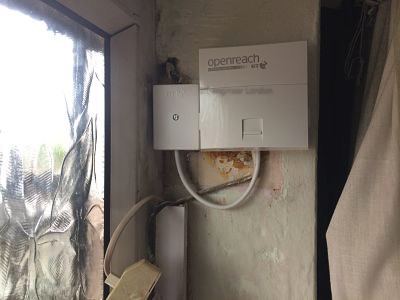
A typical job: I had a call from a flat above one of the shops near the Albany — tenant said her broadband had been getting slower for months and the engineer from her ISP told her the line was "fine at the cabinet". When I opened the master socket I found a Mk1 BT76A with twin-and-earth screwed to the back of it, running to four extensions, two of them ringing. The faceplate was original 1980s, no test socket, no filtered front plate. I swapped it for an NTE5C with an integrated VDSL filter, removed the bell wire from the active pair, and her sync speed went from 38 Mbit down to 64 Mbit up. Same line, same cabinet, same ISP — just a master socket that was finally doing its job and a ring circuit that was no longer pulling the noise margin down. That kind of thing is bread-and-butter in Deptford terraces.
Creekside and the warehouse conversions
Down by the creek, between the river and the DLR, you have the converted industrial buildings — Faircharm, Cockpit Arts, the Old Tidemill area, the small studios and live-work units that filled in around APT Gallery and the Laban. The wiring story here is different. Many of them were converted in the late 90s and early 2000s, and the developer ran a single shared Openreach feed in and split it badly. I get called when a small design business or a film-edit studio cannot understand why their VDSL keeps dropping at 3pm every afternoon.
One I remember well was a graphics studio in a Creekside unit. They had six Macs on WiFi, an FTTC line, and a router sitting on top of a metal flight case next to a fridge. The signal was unusable. I ran two Cat6 drops down through the existing conduit, terminated into a small wall-mount cabinet behind reception, fitted a Ubiquiti AP in the ceiling void, and gave them a proper PoE switch instead of the desktop unmanaged thing they had been using. Fluke certifier printout for both runs, signed and dated. They have not called back about WiFi since, which is the marker I judge by.
Working around the Overground and the DLR
Anyone who has worked around Deptford station or New Cross knows the railway is everywhere — the Overground viaducts and the cuts where the DLR runs through. That matters because the line plant runs adjacent, and the underground duct routes between the Deptford exchange and the cabinets dive under and around the rail. When I get a noisy-line call from a property close to the viaduct on Deptford Church Street or down near Surrey Canal Road, the first thing I do is a quiet-line test with my buttinski clipped to the test socket. If I get clean tone there but mush at the faceplate, it is internal wiring. If it is mushy at the test socket as well, that is an Openreach external fault — and I tell the customer to log it through their CP rather than have me chase it.
What I will say is that the FTTP rollout has been a saving grace for the older terraces around here. Where it has arrived, I am moving people off VDSL pairs that were never going to give them more than 40 Mbit and onto fibre that hits 500 Mbit comfortably. When FTTP comes in, the Openreach ONT typically lands wherever the engineer can get to — which is rarely where the customer wants the router. A neat Cat6 run from the ONT to a sensible router position, an NTE5A retained for the legacy phone if they still want one, and proper WiFi placement makes the difference between "the fibre is rubbish" and "the fibre is brilliant".
Small-business and creative-studio jobs
Deptford has more small creative businesses per square mile than almost anywhere else I work — recording studios, ceramicists, screen printers, video editors, architects in shared offices, the food businesses around Deptford Market Yard. They all need the same things and they all undervalue them until something goes wrong:
- Cat5e or Cat6 structured cabling back to a small wall cabinet, terminated properly into a patch panel, not punched into the back of a faceplate and hoped for.
- An NTE5C master socket with a VDSL or G.fast filter, located where the lead-in actually arrives — not relocated decoratively six metres away through dodgy bell wire.
- A managed PoE switch sized for the access points and IP phones, not a cheap desktop switch sitting under a desk gathering dust.
- 802.11ax (WiFi 6) access points placed by survey, not by guesswork — usually ceiling-mounted, on PoE, with channels and power tuned.
- A printed Fluke certifier report for every data run, kept on file. Useful when something does go wrong six months later.
I did a job in a yard off Resolution Way for an architect's practice that had moved out of a serviced office and into their own space. They had been quoted by a local IT firm for a full Cisco stack which was overkill and out of budget. We did two Cat6 runs per desk into a 9U wall cabinet, a small managed switch, a single ceiling AP, and a tidy NTE5C with the ONT for their FTTP service. About a day's work, certified, and they have run their entire practice off it for three years without issues.
What to have ready when you ring
If you are in SE8 or SE14 and the line or broadband is misbehaving, a one-minute phone call usually tells me what kit to bring. Useful things to know before you ring:
- Who your provider is — BT, Sky, TalkTalk, Vodafone, Hyperoptic, Community Fibre, anything else. It changes which network owns the fault.
- Whether you have a single phone socket on the wall (probably an old NTE5A) or a small plastic ONT box with a green or blue light (FTTP).
- Whether the problem is on the phone, the broadband, the WiFi specifically, or a mix.
- Whether you have already tried plugging the router directly into the master socket and bypassing extensions.
- Roughly which street, and whether you are in a converted warehouse, a Victorian terrace, or a newer block.
With those answers I can almost always tell you over the phone whether it is a five-minute job, a half-day rewire, or something that needs Openreach back out before I touch it. No charge for the conversation, and I would rather talk you out of a job than into one if it is a network fault and you do not need me on site.
WiFi in Deptford terraces — why it fails and what fixes it
Half my Deptford calls these days are not about the phone line or the broadband speed — they are about WiFi. The pattern is always similar: a customer has signed up for a 500 or 900 Mbit FTTP service, the provider has sent them a single router which they have plugged in next to the front door, and the signal does not reach the back bedroom, the kitchen extension, or the garden office. Speed tests in the same room as the router come back at 700 Mbit; speed tests on the laptop in the kitchen come back at 35 Mbit. The customer assumes the broadband is faulty. It is not — the WiFi is doing what it always does in a long Victorian terrace, which is to die after the second internal wall.
The fix is almost never a "WiFi extender" or a "WiFi booster" of the kind you buy in Argos. Those plug-in repeaters halve the available bandwidth at each hop and introduce latency. The fix is a single proper access point, ceiling-mounted in the middle of the house, hardwired back to the router on Cat6, running 802.11ax (WiFi 6) on a clean channel. That single change turns "the WiFi is unusable" into "the WiFi covers the whole house". A typical Deptford terrace needs one well-placed AP. A larger terrace with a rear extension and a loft conversion might need two. Almost never three. The trick is placement, not quantity.
What I do not do
I get asked for a lot of things that are outside the scope of what an ex-BT telephone and broadband engineer does, and it is worth being clear about them up front. I do not do TV aerial or satellite work — there are good aerial firms in Deptford for that. I do not do CCTV or alarm systems beyond running structured cabling that an alarm installer can then terminate themselves. I do not do mains electrical work — if a job needs a new socket for a router or AP, you will need a Part P electrician for that part, and I will work around them. What I do do is everything from the Openreach lead-in inwards on the telecoms and data side — sockets, cabling, master sockets, ONT relocations, structured cabling, network switches, WiFi access points, and the diagnostic work that goes around all of that.
Convoys Wharf, Deptford Market Yard and the new-build edges
The Convoys Wharf development on the river and the surrounding regeneration are slowly adding more new-build flats to Deptford's housing mix, and the Deptford Market Yard area around the railway arches has filled in with small independent businesses. I am starting to take more calls from these properties — leaseholders in the new flats who have inherited a building-wide network they do not understand, and small-business tenants in the arches who need a proper Cat6 install to support card terminals, music gear or kitchen-management systems. The work is recognisably similar to what I do elsewhere in London new-build, with the small wrinkle that Deptford's developer mix is more varied than central London's, and the standard of the original install varies more from one block to the next. Testing what is there with a Fluke is always the first step.
Across the whole patch — high street terraces, Creekside warehouse conversions, the new-build flats and the arches — the common thread is that the customer almost always thinks the problem is bigger than it is, and the actual fix is almost always smaller than they have been told to expect. The phone call costs nothing. Whether it ends in a booked visit or in advice that means you do not need one, it will save you time either way.
Ring 020 3633 1131. Advice freely given.