SE1 takes in the South Bank, Waterloo, Borough Market, Bermondsey Street and the converted wharves running east towards Tower Bridge. Restaurants and bars in the railway arches under London Bridge, residential conversions inside former tea warehouses on Shad Thames, tech offices around Southwark Street, the occasional Grade II listed terrace tucked behind Borough High Street — and the wiring is as mixed as the buildings. I've been working SE1 jobs long enough to know which streets have been re-cabled by OpenReach in the last five years and which still have the original 1980s aluminium drop wire dangling over a railway arch.
The everyday brief in SE1 is more commercial than most of the city. Restaurants need reliable card processing during service. Studios behind the South Bank need a clean wired backbone for cameras and edit suites. Residential conversions in the wharves need WiFi that works through brick walls eighteen inches thick. The bread-and-butter telephone and broadband work — master sockets, noisy lines, broadband not matching the bill, WiFi black-spots, Cat6 runs — looks the same on paper as anywhere else. The buildings are what make SE1 distinct.
Wharves, warehouses and what they do to broadband
Walk along Shad Thames or along Bermondsey Wall and almost every residential building you pass is a 19th-century warehouse conversion. Some of these conversions date from the late 1980s when the docks were redeveloped, some from the 2000s, some are mid-2010s. The thing they all have in common is exceptionally thick brick walls — eighteen inches of London stock with the original timber and iron tying still in place. A wireless router placed in the corner of a flat is not going to deliver useful signal to the far end of that flat through that geometry, no matter what the box on the router promises.
What I do in these flats is invariably the same. Pull a Cat6 from wherever the broadband terminates (often a cupboard near the front door of the flat, sometimes a communal data room on the floor below) to a wall-mounted access point in the centre of the living space. Where the developer has helpfully left structured cabling in place, we patch into it. Where they haven't, we run new cable along skirting, behind original timber beams, or up into a ceiling void where the conversion left one. The Fluke certifier tells the customer the cable is genuinely Cat6 and meets the standard.
Some patterns that recur in SE1 wharf-conversion work:
- Master sockets installed in a communal riser room with no individual flat termination, so every flat shares a tail.
- Original copper drop wire from the river-facing elevation that takes a beating from the salt air and needs replacing more often than you'd expect.
- Listed-building consent restrictions on external work — even in commercial conversions.
- Exposed-beam ceilings that the owner wants kept clean, requiring discreet trunking rather than chasing.
- Sub-letting via short-let platforms which adds load to the WiFi without the original developer's network being specced for it.
Three SE1 jobs from the last quarter
The first was a wine bar on Bermondsey Street, just south of Tower Bridge Road. Their card terminal kept disconnecting during evening service, which is the kind of fault that sends owners up the wall. The line tested fine at the master socket. The router was in a cupboard above the bar shelf with the WAN cable trailing across the back of the spirit shelves. The card terminal sat at the host station, ten metres of fairly busy room away, connected over 2.4GHz WiFi alongside everyone's phone and several IoT devices in the kitchen. I ran a single Cat6 along the top of the picture rail behind the bar, drilled through one stud wall, and put an ethernet drop at the host station. Set up a separate management VLAN for the card terminal so it wasn't competing with guests for airtime. Faults stopped that night.
The second was a residential client in Butler's Wharf — one of the more famous Shad Thames conversions. The flat had originally been built for an analog phone line and a single PC; the new owner was working from home on video calls all day from a corner of the kitchen, with the router still sitting where the developer put it in a cupboard behind the front door. WiFi at the kitchen desk was around 25 Mbps and dropping out under load. I ran a Cat6 along an existing trunked run behind the original timber beams to a wall-mounted access point in the central living area. The cable disappeared completely against the dark-stained beam. Speeds at the kitchen desk are now consistent and meeting around 600 Mbps on the 5GHz radio.
The third was a small post-production house in a railway arch off Webber Street, near The Cut. They had four edit suites, a server room and a meeting room, with patchy cabling installed by a builder during the fit-out two years earlier. None of it had been tested. Every time they tried to transfer footage between the server and an edit suite the connection topped out at about gigabit but with significant packet loss. I re-terminated every existing run on proper Cat6 keystones, ran two new drops for the meeting room, fitted a small patch panel in the server room, and Fluke-certified the lot. Every run now passes Cat6 at full spec. The packet loss disappeared the same afternoon.
Restaurants and the railway arches
A real specialism in SE1 is the railway-arch unit. From Borough Market all the way along to Bermondsey and Druid Street, the arches house dozens of food businesses — bakeries, breweries, restaurants, butchers, coffee roasters. The brickwork is dense, the spaces are damp, and the structural geometry doesn't co-operate with conventional cable routing. Drilling through an arch wall needs care, and any cable that has to enter from outside has to be properly weather-protected because these spaces leak.
For these units I always recommend wired everything for tills, card readers and back-office equipment. WiFi for guests is fine; WiFi for revenue-critical kit is not. The cost difference between a proper wired install and a wireless one in a railway arch is small, and the reliability difference is substantial.
Listed terraces and Borough's older streets
South of Borough Market, around Park Street, Stoney Street and the older terraces on Redcross Way, there's still a fair amount of Grade II listed housing. The constraints are similar to north London listed work — no chasing external walls, no fresh holes in the front elevation, careful work internally to avoid damaging original plasterwork or panelling. The OpenReach drop usually has to follow the route it originally followed, which means working with what's there rather than starting fresh.
I carry a small kit of conservation-grade trunking, low-profile faceplates and discreet cable management gear specifically for these jobs. If a customer needs a genuinely invisible run, that's chase-and-make-good — and I'll be straight on the phone that finishing work is a separate trade.
FTTC, FTTP and the SE1 picture
SE1 sits across two main exchange catchments — Waterloo and London Bridge — with cabinets distributed through the area. FTTC has been widely available for years. FTTP rollout in SE1 has been quicker than average because OpenReach has prioritised the dense commercial streets; a lot of the wharf conversions and many of the offices around Southwark Street are now FTTP-eligible. Whether a specific address can take FTTP depends on whether OpenReach has fibred the building, not just the street, so I'll check before quoting.
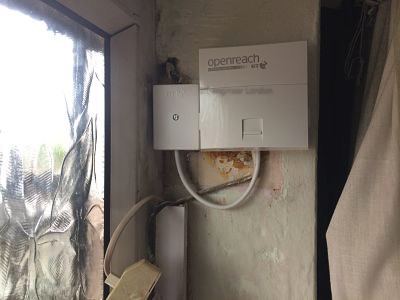
Where FTTP is in place, the install replaces the NTE5 master socket with an ONT — usually wall-mounted in the same location — and the data side becomes more important than the copper side. The internal structured cabling is then what determines the speed at your desk, not the line.
What to tell me on the phone
For SE1 jobs the useful information is:
- Type of premises — wharf flat, listed house, railway arch unit, office, restaurant.
- Which ISP and what product — FTTC, FTTP, full-fibre business line.
- Where the master socket or ONT lives.
- Speeds at the router versus what's being paid for.
- For commercial premises, what's actually failing — voice, cards, internal network, WiFi.
Most SE1 jobs can be scoped from a short call. Larger commercial fit-outs need a site visit. I work across the borough every week, cover weekdays and Saturdays, and can usually attend within 24 to 48 hours.
Working around live restaurant service and live offices
One particular skill required in SE1 work is being able to do meaningful telecoms work without shutting a business down. A restaurant on Borough High Street can't close while we re-wire its EPOS network. An office on Tooley Street can't have its trading desks offline for a morning while we move a patch panel. The work has to happen around the operation. Sometimes that means working overnight; more often it means staging the changes so that any individual cutover is short and reversible.
For restaurants the typical staging is: visit during a quieter midweek lunchtime to survey, agree the cabling routes and the cutover plan, return on a Sunday evening or before opening on a Monday to do the actual install, and stay on site through first service to confirm the new install is behaving. For offices we often work weekends or evenings on anything that requires a switch reboot or a patch panel change. I plan these jobs with the customer's operations manager rather than assuming I can just turn up.
Short-let flats and serviced apartments
SE1 has an unusual concentration of short-let flats and serviced apartments — particularly around the Bermondsey wharves, in the newer blocks near Tate Modern, and in the older converted terraces around Borough. The telecoms challenges here are slightly different from straightforward residential or commercial work. Short-let operators need reliable, simple WiFi that successive guests can connect to without an engineer's help, plus a router and access point setup that can survive being unplugged and plugged back in repeatedly by cleaning staff who don't know what any of the cables do.
The approach I take with short-let units:
- Mount the router and any access points where guests and cleaners can't reach them — typically high on a wall or in a locked cupboard.
- Use a simple SSID and a printed guest-WiFi card.
- Configure auto-recovery on the router so that if it crashes it restarts itself.
- Specify equipment with proper cloud management so the operator can see whether the WiFi is up without sending someone to the flat.
- Document the install clearly for the next person who has to look at it.
None of this is exotic. It just acknowledges that a serviced apartment is not a normal residential install — it has the technical needs of a small business with the budget and visual constraints of a home.
What the finished SE1 install looks like
When I finish a job in SE1 the customer should be able to expect a current-spec master socket or ONT, a clean Cat6 backbone with a Fluke test report, properly placed wireless access points where needed, and any redundant cabling removed. Commercial customers get a written description of what was done so they can hand it to the next IT contractor without explanation. Residential customers get a verbal walk-through of the install and where to find what.
SE1 work spans the busiest part of London. Diary slots fill quickly, especially the Saturday and early-morning slots that commercial customers need. Ring me on 020 3633 1131 to talk through what you need and we'll find a slot that works.
One last note on SE1 specifically: parking. The borough is heavily controlled and getting a van to a job near Borough Market or Bermondsey Street at the wrong time of day can be a real exercise. I'll always confirm with the customer up front whether there's loading access, whether a contractor permit is needed, and what time of day works best for the access. For jobs in the wharf conversions and the tighter back streets I sometimes plan an early-morning start specifically to avoid the worst of the daytime restrictions. Customers who can confirm parking arrangements in advance get a quicker visit, simply because I'm not spending fifteen minutes circling to find a legal space.
Ring 020 3633 1131. Advice freely given.