Elephant & Castle has been rebuilt around itself over the last decade — the old shopping centre gone, the Northern line interchange remodelled, and a ring of new high-rise residential towers in SE1 and SE17 that did not exist when I first started working this patch. Around the new build sit the Victorian and Edwardian terraces of Walworth, Kennington and the streets running off the Old Kent Road. Two completely different wiring stories on the same postcode, and I work across both of them.
I am an ex-BT engineer covering Elephant & Castle, Walworth, Kennington and the SE1/SE17 boundary, and I have been the local call-out here since 2011. The towers ring for one set of reasons — building-wide cabling, shared FTTP risers, intercom-network confusion — and the older terraces ring for another — bell-wire daisy chains, noisy lines, broadband that has never been tuned. Same engineer for both, but you have to know which one you are looking at the moment you walk in.
The new towers — Strata, Elephant Park, the riverside blocks
The high-rises around the new town centre — Strata, the One The Elephant block, the Elephant Park development behind it, the Trafalgar Place and Sayer Street builds — are mostly wired with a structured Cat6 backbone from a basement comms room up through risers on each core. Each flat gets one or two RJ45 sockets in the hallway feeding a small distribution point, with the actual telecoms and broadband terminating either there or in a kitchen cupboard. When they work, they work very well. When they go wrong, the typical resident has no idea where to start because none of it looks like a phone socket they recognise.
A call I took from a flat on the 18th floor of one of the Elephant Park towers: the resident had upgraded to a 900 Mbit FTTP package, plugged the router into the kitchen socket, and was getting 80 Mbit on speed tests. The ISP support line had her changing channels on the WiFi and rebooting the router for two weeks. When I got up there I traced the actual ONT into a hallway distribution box, found that the developer's electrician had run a single Cat5e (not Cat6) from the ONT to the kitchen, and that the patch in the box was loose. I replaced the patch lead, switched her to a 5 GHz channel that wasn't being used by every other flat on the floor, and her speed went to 870 Mbit on the iPerf test I ran. That is a building-issue job — nothing to do with the line, everything to do with the structured cabling that arrived with the flat.
Walworth Road and the Victorian terraces
Walk south from the station down Walworth Road and you are in a different world — the East Street market, the side streets off Camberwell Road, the terraces around Larcom Street and Liverpool Grove. The Pullens Buildings, the Sutherland Square conservation area, the streets running into Kennington Park. These are 1880s to 1910 terraces, almost all converted into upper and lower flats, with telecoms wiring that has been added, ripped out, added again, and never properly documented.
I had a job on a side street off the Walworth Road where the customer had been told by three different ISPs that her line was "fine" and her crackling was "internal". Her master socket was an old BT76A with no test socket, screwed onto skirting next to a radiator. The bell wire (the orange/white, the legacy ringing wire on terminal 3) was running through a wet patch under the floorboards. I lifted the floor, found water sitting against the cable from a slow leak under the bath, dried it out, removed the bell wire entirely, fitted an NTE5C with the proper filtered faceplate, and the crackle went. Twenty minutes of actual work, an hour and a half of finding the fault. That is Walworth.
Kennington edge and the borough boundary
Up towards Kennington Park, Kennington Lane and the streets running over towards Vauxhall, the property mix shifts again — Georgian and early Victorian houses, more of them owner-occupied and single-family, plus the council blocks around the park. The Georgian houses are interesting because the wiring rules are different — listed and conservation-area properties cannot have surface trunking up the front, the lead-in needs to be routed sympathetically, and the master socket needs to sit somewhere that does not look like a 1990s afterthought.
One of my recent Kennington jobs was a Georgian terrace on a side road off the Lane. The owner had taken delivery of a new FTTP install, and the Openreach engineer had drilled through the front cornice and run the fibre across the picture rail to terminate in the front room. It was correctly installed, functionally fine, and aesthetically a disaster. I moved the ONT up into the loft hatch cupboard, ran a single Cat6 down through an existing cable run inside a chimney breast, and gave them a router position in the upstairs landing where it covered the whole house. The original drill point on the cornice we filled and painted. The customer's surveyor was happy, the customer was happy, and the listed-building officer would have nothing to complain about.
What I actually fix in SE1 and SE17
Across both the towers and the terraces, the bulk of my work in Elephant & Castle comes down to a fairly short list:
- BT master socket installs and moves — usually replacing old NTE5A or BT76 units with NTE5C faceplates that have proper filtering built in.
- Noisy line diagnosis — buttinski on the test socket, walk it back to find which extension or which dead bell-wire is causing the problem.
- VDSL and FTTC speed tuning — checking sync rates, noise margins, and seeing whether the real issue is at the line or in the internal wiring.
- FTTP relocations — moving the ONT or extending its Cat6 patch to where the router actually needs to live, not where the install engineer left it.
- Cat5e and Cat6 runs for hardwired ethernet — gaming PCs, IPTV boxes, garden offices, home-working setups.
- WiFi access-point installs — 802.11ax APs on PoE, placed properly after a quick survey, not random plug-in repeaters in the hallway.
- Small-business cabling for the ground-floor commercial units around Elephant Park and the rebuilt Castle Square — patch panels, certified runs, neat finishes.
I take a fair number of calls from leaseholders in the new towers who have been told the building's "concierge" or "FM team" cannot help them with their flat's internal cabling. That is correct — the building maintains the riser and the shared infrastructure up to the flat's incoming point, after which it is the leaseholder's responsibility. I bridge that gap. I can also liaise with the building management if access to the comms cupboard on the floor is needed.
Calling out — what helps
Before you ring, two minutes of looking around saves a lot of back-and-forth:
- Identify your provider. Is the bill from BT, Sky, Vodafone, Hyperoptic, Community Fibre, G.Network, or one of the building-wide deals the new developments are sold with?
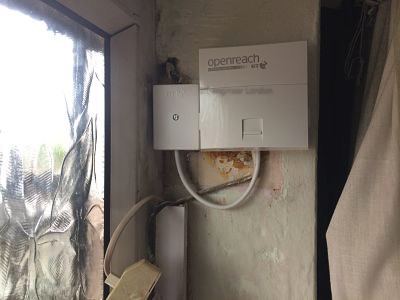
- Find your incoming kit. Is there a small white or grey plastic box on the wall with a green or blue LED labelled ONT? That is FTTP. Is there an older single phone socket on the wall? That is the legacy NTE5. Some new flats have both.
- Tell me what is actually wrong. "WiFi is rubbish" is different from "the phone is crackly" is different from "the broadband cuts out every evening". Each one points to a different bit of kit.
- Mention the building. "Strata, 12th floor" tells me a different story than "1890s flat above a shop on Walworth Road" and I will arrive with different test gear.
If you are in SE1 or SE17 and the line, broadband or network is misbehaving, ring me. I would rather spend five minutes diagnosing over the phone than have you book a visit you do not need.
The digital voice migration — what is going on, and why your old phone may have gone dead
One thing that has been driving a lot of my Elephant & Castle calls in the last year is the BT digital voice migration. The old copper phone network is being switched off region by region, and properties that previously had a traditional landline are now having their phone service delivered over the broadband router instead. In most cases the customer's existing phones still work — they just plug into a different socket on the back of the router rather than into the wall socket. In other cases the migration has been done badly, or the customer has lost service entirely because the install engineer did not configure the digital voice line at the same time as the FTTP went in.
I get called when this has happened and the customer cannot get through to their ISP support line (which is often a problem in itself if their only phone is the line that has just gone dead). The fix is usually quick — plug a handset into the green socket on the router, ring the digital voice number from a mobile to confirm it rings, and if it does not, log a case with the provider. If the customer still wants the wall sockets around the house to work (some do — for fax machines, alarm-system dialers, or simply because they want the phones back where they always were), I can fit a clean adaptor at the router that re-energises the existing wall sockets so all the old phones in the house ring as before. That is a fifteen-minute job done properly and not something most ISPs will help with.
Why the FTTP install engineer never quite gets it right
The Openreach engineers who install FTTP are doing a focused job — get the fibre into the building, terminate the ONT, hand over to the CP. They are not there to design your home network, and they are not paid to relocate the ONT to wherever you would like the router to live. The result is that FTTP ONTs end up in odd places — basement cupboards, under-stairs cupboards, the corner of a hallway, halfway up a stairwell — because that is where the fibre lead-in arrived and that is where the engineer terminated it. The customer then plugs the router in there, and the WiFi covers the cupboard beautifully and nothing else.
A lot of what I do in Elephant & Castle is post-install ONT relocation and Cat6 extension. I take the ONT off the wall where Openreach put it, run a clean Cat6 to where the customer actually wants the router, and remount the ONT either at the new position or somewhere sensible like a high cupboard. The fibre patch lead between the wall-mounted fibre termination point and the ONT itself is the only piece I cannot extend (it is a fragile glass cable in a specific connector), but everything beyond the ONT is just ethernet and that is easy. Same FTTP service, same speed, but the router is now in a position where the WiFi reaches the whole flat.
The Walworth Road shops and the ground-floor commercial work
Walworth Road, East Street, the parade of small shops and cafes around the rebuilt Castle Square — these are the small commercial tenancies that come with the same wiring needs as anywhere else but at smaller scale. A typical job is a new takeaway or barber's shop moving in and needing a card terminal, a couple of CCTV feeds (cabling, not the cameras themselves), background music WiFi, and a tidy phone setup. None of that is glamorous work but it is the daily reality of the area, and I do plenty of it across SE17 and the southern edge of SE1. The pattern is always the same: small wall cabinet, Cat6 drops to each point of sale, a managed PoE switch sized for the load, a single 802.11ax AP, an NTE5C if they have copper or a clean ONT install if they have FTTP, and a printed test report at the end. Half a day to a day's work, finished, working, certified.
Ring 020 3633 1131. Advice freely given.