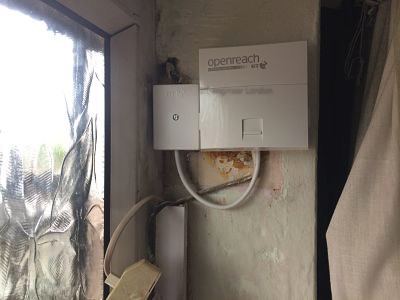
Edmonton covers N9 and N18 — from the railway line at Silver Street up through Fore Street to the North Circular and Angel Edmonton. It's a mix of late-Victorian terraces, post-war social housing estates, small commercial premises along Fore Street and Hertford Road, and a steady stream of light-industrial units towards Meridian Way. Whether the job is a corner-shop phone system, a family flat that needs broadband upstairs, or a unit on the Eley Industrial Estate that wants proper structured cabling, I cover both the residential and small-business side.
The everyday work that takes me to Edmonton is much like anywhere — moving or installing master sockets, tracing crackling lines back to their source, sorting WiFi that won't cover a back kitchen, running Cat5e or Cat6 for offices and shop tills. What changes is the building stock. Edmonton has a much greater mix of housing types than the postcodes south of it, and that affects how we approach each job.
Edmonton's building stock — what to expect
The housing in Edmonton splits roughly into four groups: Victorian and Edwardian terraces clustered along the older streets near Edmonton Green and Bury Street; inter-war semis on the streets towards Bush Hill Park and Winchmore Hill; substantial post-war local authority estates including the Edmonton Green estate itself; and newer mid-rise apartment blocks built since the 2000s. Each has its own wiring traditions.
The terraces along Hertford Road and Sterling Way usually have the original GPO drop somewhere on the front elevation and a long-established internal extension. The post-war flats often have communal cabling that was specified by the local authority in the 1960s and has been patched and re-patched ever since. The newer apartment blocks usually have a structured cabling cupboard somewhere on each floor but the cables to individual flats are often missing or unlabelled.
Some common Edmonton patterns:
- Master sockets in the meter cupboard of a converted flat, with the actual living space at the back of the building thirty metres of bad wiring away.
- Communal phone wiring shared between multiple flats in a post-war block, often paralleled rather than properly broken out.
- Corner shops and takeaway units on Fore Street with a single phone line trying to do voice, card processing and a back-office router.
- Newer apartment blocks where the developer specified Cat5e to each flat but never punched it down properly.
- Family houses on streets like Brettenham Road or Bounces Road with WiFi that drops out in the back bedroom because the router is in the front porch.
Three Edmonton jobs from recent months
The first was a butcher on Fore Street, near Edmonton Green. He'd been having intermittent failures on his card reader for months — three or four declines a day, always at random. Every call to the bank told him it was a network problem; every call to his ISP told him the line tested fine. I attended on a Tuesday morning. The line ran from a master socket in the cellar, up the cellar steps in CW1308 stapled at right-angles to a fluorescent light fitting, into the shop and round to the card reader via a five-way splitter. The fluorescent tube was throwing line noise straight into the cable. We pulled the staple-mount, re-ran a fresh CW1308 well clear of the lighting, fitted a proper NTE5C with a single extension to the till, and the declines stopped that afternoon.
The second was a family flat in a 1960s block off Bury Street West. The tenant's daughter was doing GCSEs and needed reliable WiFi in her bedroom, which sat at the far end of the flat behind two interior walls and a chimney breast. The router was a basic ISP unit in the hall. I did a quick site survey, measured the 5GHz signal at the desk (sub-30 dBm — effectively dead), and recommended a wired access point. The communal phone room sits on the ground floor and is properly fed; the flat already had a CW1308 going up to a hallway socket. We dropped a Cat6 alongside that existing cable through the same cable-tray run, fitted an 802.11ax access point in the corridor between the rooms, and her speeds at the desk went from unusable to over 200 Mbps on the 5GHz radio. The tenant kept the same ISP, the same router, the same package.
The third was a small accountancy practice above a unit on Angel Place. Three staff, two desktop PCs and a printer, one ageing analogue line and a router struggling to keep up with their cloud accounting package. I attended to look at the broadband and ended up rebuilding the lot — the practice had been running on an NTE5A from 2003 with a daisy-chain of internal extension wiring to every desk. We fitted a current NTE5C with VDSL faceplate, ran three Cat6 drops from a small wall-mounted patch panel to the three desks and one to the printer, configured a basic managed switch, and tested every termination with a Fluke certifier. Their accounting software stopped timing out, the printer stopped dropping off the network, and the staff stopped blaming each other when the system was slow.
Fore Street and the small-business end
Fore Street running through N9 and N18 is the main commercial spine of Edmonton. The mix is independent shops, takeaways, salons, supermarkets, dental and medical practices. Their telecoms needs are usually modest in headline terms — a phone line, a router, card payments — but the consequences of failure are big. A takeaway that can't take a card at lunchtime is losing real money. A dental practice that can't connect to its records system has to send patients away.
The work I do for these customers is mostly about reliability rather than headline speed. Proper master socket termination. Clean internal cabling, run away from any heavy electrical equipment. Decent business-grade routers rather than the cheap ISP unit. Separate networks for staff use and customer WiFi. Where the business is busy enough, we'll specify a second line so that voice and broadband don't share the same fault path.
The post-war estates
Edmonton has substantial post-war housing — Edmonton Green, the streets around the old Joyce Avenue estate, blocks along Park Lane and Plevna Road. These properties are perfectly fine to work in but each block has its own quirks. Some have a properly maintained communal phone room where every flat is individually broken out; others have a cupboard you can barely get into where decades of cabling have been piled in on top of each other.
If you live in one of these blocks and you're getting odd line behaviour, the issue is often upstream of your flat in the communal wiring. I can usually identify whether the fault is yours to fix or whether it needs OpenReach to attend the communal infrastructure. Saves the call-out where it's not appropriate.
FTTC, FTTP and the Edmonton exchange
Edmonton sits in the Tottenham exchange catchment for most of its postcodes, with cabinets distributed along the main roads. FTTC has been live for years and most addresses can take a respectable speed if the internal wiring is clean. FTTP is rolling through N9 and N18 — the pace has picked up over the last two years and a lot of streets now have at least scheduled availability. I check the OpenReach checker for any address before committing to a particular install.
One pattern worth noting in Edmonton: a fair number of older properties still have aluminium drop wire from the early 1990s that, decades later, is the limiting factor on their broadband. If your neighbours are getting noticeably better speeds and your internal wiring is already clean, it's worth asking OpenReach to inspect the drop wire — that's where the noise sometimes lives.
What I'd ask on the phone
To quote an Edmonton job sensibly, the useful information is:
- What kind of property — terrace, post-war flat, shop, office.
- Which ISP and what speed you're paying for versus getting.
- Where the master socket is, if you know.
- Where the problem is occurring — at the master, at the router, in a specific room.
- For a business, what's actually failing — voice, card payments, internet, all of the above.
Most Edmonton jobs can be properly priced from a five-minute conversation. I cover the area regularly, work weekdays and Saturdays, and can typically attend within 24 to 48 hours. Same-day is often possible if the diary allows and the work isn't going to need ordering parts.
Small businesses on the Fore Street corridor
The commercial spine of Edmonton runs along Fore Street, Hertford Road and Angel Edmonton, with secondary clusters around Edmonton Green shopping centre and the smaller parades on Silver Street and Church Street. The businesses here are mostly independent — barbers, takeaways, dry cleaners, tailors, mini-supermarkets, computer repair shops, accountants, dental and medical practices. They run on tight margins, so when something stops working the priority is to get it working again quickly without spending money that doesn't need to be spent.
The diagnostic pattern for a typical Fore Street small-business job:
- Establish exactly what's failing — voice, broadband, card payments, EPOS, all of the above.
- Check the master socket and test the line behind the engineer's faceplate to remove internal wiring from the picture.
- Identify any internal cabling that's running alongside fluorescent lighting, refrigeration units or other noise sources.
- Look at how the router and switch are sited — are they in a sensible, cool, accessible location?
- Check whether the WiFi is genuinely the bottleneck or whether revenue-critical kit could be wired instead.
The cheapest fix is usually the right fix. If a salon's card reader is dropping because of fluorescent-tube interference on a poorly-run extension, the answer is to re-run the extension properly, not to buy a new router. If a takeaway's till is on WiFi and the WiFi is congested with phones and CCTV, the answer is to wire the till and put consumer devices on a separate SSID. Most small-business problems in Edmonton are configuration and cabling problems, not equipment problems.
Residential expectations in N9 and N18
The residential side in Edmonton has its own typical pattern. A lot of properties are tenanted, which means that landlords or letting agents are often the people commissioning work rather than the people living in the flat. That matters because the brief is usually ‘make this work for the next tenant’ rather than ‘make this beautiful for the owner’. The standard I aim for is the same regardless — current-spec master socket, clean internal wiring, properly tested — but the design decisions about visible cable management are different. A landlord usually wants a robust install that doesn't need re-doing in two years' time; an owner-occupier sometimes wants the cabling to disappear entirely.
For tenants ringing me directly: I'll happily come and look at the wiring, but if the property is rented you may need to ask the landlord's permission for anything that involves drilling or fitting new sockets. I can usually do a useful improvement without any physical changes — re-terminating an existing master socket, removing redundant extension wiring, replacing a failing faceplate — and that often resolves the original complaint without needing landlord sign-off.
A note on the older social-housing blocks
Some of the larger post-war blocks in Edmonton have communal phone infrastructure that hasn't been properly maintained for decades. If you live in one of these blocks and your line is failing intermittently — particularly if the fault appears at the same time of day every day, or appears every time a particular appliance is used in another flat — the chances are good that the issue is in the shared cabling rather than your flat. I can identify which side of the demarcation the fault sits on, and if it's communal I'll tell you that's something the freeholder or OpenReach needs to address rather than charging for work that won't fix it.
The honest answer is sometimes ‘this is not your problem to fix’, and that's worth saying clearly so customers don't keep paying for repeated visits to address symptoms of an upstream cause.
Ring 020 3633 1131. Advice freely given.