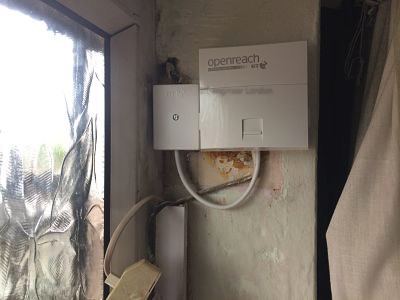
Leytonstone sits at the eastern end of the Central line, with the Victorian terraces of Bushwood and the post-war estates around Leyton. The Stratford regeneration has changed traffic patterns out here — but the wiring inside many of these houses has stayed the same since the 1970s. I've been working E11 jobs for over a decade, and I still find houses with the original BT cables stapled along the picture rail.
The work that takes us to Leytonstone is mostly the same as anywhere else: master sockets, noisy lines, broadband that doesn't match the bill, WiFi that won't reach the back room, Cat5e/Cat6 for new offices. What changes is the building — and the wiring history that comes with it.
Leytonstone — the lay of the land
E11 covers Leytonstone proper, Bushwood, Cann Hall, Snaresbrook and a slice of Wanstead. It's bordered by Wanstead Flats to the south-east, Epping Forest to the north, and the Central line corridor running through the middle. The character changes street by street: late-Victorian terraces around Browning Road, Bushwood Road and Mayville Road; substantial Edwardian houses up around Snaresbrook and Hollybush Hill; smaller interwar terraces around Cann Hall and Harrow Green; and post-war LCC and GLC blocks around the High Road and Leyton Green. The High Road itself runs from Leytonstone station all the way down to Stratford, lined with shops, with flats above most of them.
Streets I'm in regularly: Browning Road, Bushwood Road, Mayville Road, Trinity Close, Wallwood Road, Aylmer Road, Twickenham Road, Bulwer Road, Hainault Road, Cavendish Drive, Fairlop Road, Hartley Road, Davies Lane, Harrow Road, Crownfield Road, and the various streets running off Wanstead Flats. The High Road shops between Church Lane and the station are a regular call too — flats above retail are some of the most common Leytonstone jobs.
Trains, buses and getting to your door
The Central line is the obvious artery — Leytonstone, Snaresbrook and Leyton stations cover most of the postcode. Leytonstone High Road on the Overground (Gospel Oak to Barking Riverside) is another useful one, especially for jobs around the south of the patch. For Wanstead Flats and the Cann Hall side, the W19 bus is useful. The North Circular passes the east edge, which means for jobs in the upper part of E11 I often come in by car. Parking in Leytonstone is mostly fine outside the controlled zones, but the streets immediately around Leytonstone Tube and the High Road are paid-bay only on weekdays.
The Leytonstone building stock and what it means for your wiring
- Victorian terraces (Bushwood, Browning Road, Mayville Road area). Two-up two-down or three-bedroom houses, original drop wire from the overhead pole on the pavement, master socket typically in the front room near the bay window. Most extensions are surface-run along the skirting in old solid-core cable. Replacing the master with an NTE5C and re-terminating extensions cleans up the line and usually fixes long-standing noise complaints.
- Edwardian semis (Snaresbrook, Hollybush Hill, Aylmer Road). Larger houses, generous voids above the hall and behind the bath panel. Good candidates for hidden Cat6 runs to a garden office or a loft conversion.
- Interwar terraces (Cann Hall, Harrow Green). Smaller footprint, often with a single front room that's been opened up into a through-lounge. The master socket may be on a chimney breast that's no longer there — I've found phone cables ending in mid-air behind plasterboard more times than I can count.
- Flats above shops (High Road, Church Lane). Notoriously bad for line quality. Power supplies for shop signage and air-conditioning cause REIN (Repetitive Electrical Impulse Noise) that wrecks broadband sync rates. Screened cable and a properly grounded NTE5C make a real difference here.
- Post-war estates (Cathall, Avenue Road, Leyton Green). Concrete walls, master socket near the front door, intercom often sharing the riser. WiFi rarely reaches the back bedroom — a wired AP solves it.
- New-build infill (around Leytonstone station and the High Road). Mostly fibre-ready, with the ONT in a hallway cupboard. The router placement set by the developer is usually wrong; a small reorganisation and an extra AP fixes coverage.
Three jobs from the Leytonstone diary
Bushwood Road, E11. A two-bedroom Victorian terrace where the broadband had been "slow for years". The owner had been told by his provider it was "the best the line can do". I traced the run from the NTE5 in the front room and found it spliced into an old extension with a chocolate-block connector, hidden inside the picture rail. The splice had partially corroded over time. Replaced the run with fresh CW1308 from a new NTE5C, properly terminated on the customer-side faceplate, and the sync rate jumped from 24 Mbps to 67 Mbps on the same FTTC profile. Same line, same provider — different wiring.
Mayville Road, E11. A first-floor flat in a converted Victorian house. The tenant complained the line crackled when it rained. The master socket was bolted to an external rear wall, with the drop wire entering through a hole that had been crudely sealed with builder's foam. Water had been wicking down the cable and getting into the joint. Re-terminated the drop at the building's boundary point on a properly weatherproofed junction box, ran fresh CW1308 through the wall into a new NTE5C inside the flat. The crackling stopped instantly.
High Road, Leytonstone. A small accountancy practice above a kebab shop wanted Cat6 to four desks, a wall-mounted patch panel and a proper 802.11ax AP. The shop below ran refrigeration that was throwing REIN onto the phone line. We installed screened Cat6, grounded the patch panel properly, and fitted an NTE5C with VDSL faceplate at the entry point. The accountants now get a stable 70 Mbps VDSL line and no more dropped calls. Fluke-certified, signed off, finished in a day.
What I bring on a Leytonstone job
- NTE5A and NTE5C master sockets, plus VDSL/FTTC faceplates and FTTP-compatible accessories
- CW1308 internal voice cable and screened variants for noisy commercial premises
- Cat5e, Cat6 and Cat6a — solid and stranded, in multiple jacket colours
- Fluke DSX cable certifier with full channel adapters
- Krone and IDC tools, gel-filled connectors for damp joints
- Line tester for tip/ring, REIN, voltage drops and noise margin
- UniFi and TP-Link Omada access points for 802.11ax installs
- Cable rods, both fibreglass and steel
Leytonstone exchange and line types
E11 is largely served by the Leytonstone exchange, with parts of the south of the postcode sitting on Leyton. Loop lengths are mostly reasonable — under a kilometre for most of the residential streets — which means FTTC is usually decent and FTTP is rolling out steadily. The classic Leytonstone problem isn't the line from the cabinet; it's the cable inside the house. The original drop wire is often fine. It's the thirty-year-old extension run that wrecks the broadband.
Why ex-BT matters here
I trained at BT and worked on Openreach jobs in east London before going independent in 2011. That means I know the cabling history of streets like Browning Road and Bushwood Road. I know which estates were wired in the 1970s and which had a refresh in the 1990s. And I know how to talk to Openreach when a fault sits on their side of the boundary point rather than yours. A proper engineer with the right test set finds the actual fault — not a guess — and fixes it properly the first time.
WiFi in Leytonstone — what actually works
The single most common complaint I get from Leytonstone households is "the WiFi doesn't reach the back bedroom" or "the loft conversion is a dead spot". The pattern is almost always the same. The router is wherever the master socket is — usually the front room or the hallway. The back of the house is two or three solid Victorian walls away. The loft is above a thick lath-and-plaster ceiling. No router placed at the front of a three-storey terrace is going to cover the loft properly with a single antenna. The right answer is a wired access point at the far end of the house, on Cat6 from the router. One AP solves most coverage problems; two solves all of them.
For loft conversions in particular, I run Cat6 up from the master socket location to a discreet PoE AP on the loft ceiling. Same trick for garden offices — a buried external-grade Cat6 run from the house to the office gives full-speed internet and a wired AP at the end, which beats any wireless extender ever made. 802.11ax (WiFi 6) is now the standard for new APs and gives genuine speed improvements in dense channel environments, which most Leytonstone streets now are.
Garden offices and loft conversions — a Leytonstone speciality
Leytonstone has a high proportion of households who've extended into the loft or built a garden office. Both are big drivers of my work in E11. The reason is obvious: the original house WiFi was never designed to reach a loft 8 metres above the router, or a garden office 15 metres down the garden behind two brick walls. The standard fixes:
- Loft conversions. A single Cat6 drop from the router location up to a ceiling AP in the loft. Full 802.11ax coverage, no dead spots, no halving of bandwidth at each hop the way a repeater would do.
- Garden offices. External-grade Cat6 (UV-resistant jacket) buried in conduit at 450mm depth from the house to the office. Terminated in a small wall-mount faceplate at each end. PoE access point inside the office, plus a wall data outlet for hardwired equipment. Speed is identical to the indoor LAN.
- Side returns and rear extensions. Cat6 in the void above the ceiling, dropping to a ceiling AP at the rear of the extension. The kitchen at the back of a Victorian terrace is the classic WiFi dead spot, and a single AP cures it.
FTTP rollout in Leytonstone
FTTP coverage in E11 has improved significantly. Streets across Leytonstone, Bushwood, Cann Hall and parts of Snaresbrook now have full-fibre availability — speeds an order of magnitude faster than the FTTC most households were on a few years ago. The switchover from copper voice services to fibre is well underway, and many of my calls now are about preparing households for that change: making sure the ONT is in the right place, the router has a good central position, and the WiFi has been planned around the new entry point rather than the old master socket location. ADSL is now rare in Leytonstone and being phased out entirely.
What to expect when you ring
A typical Leytonstone booking goes like this. Ring with the problem — "the line crackles", "the broadband is slow", "the WiFi doesn't reach the loft". I'll ask the postcode, the kind of house, what your provider has said, what kit you have. From there I can usually tell you on the phone what's likely going on and roughly what fixing it will involve. If it's something I can do, I'll book a time that suits. Most Leytonstone jobs are single-visit — I bring everything I need with me. If it turns out the fault is on Openreach's side of the boundary, I'll tell you that honestly and explain how to escalate it with your provider rather than charging you for work that isn't yours.
Wanstead Flats, Snaresbrook and the edges of the patch
Leytonstone shades into Wanstead at its eastern edge, and the housing changes accordingly. The streets around Wanstead Flats — Aylmer Road, Hollybush Hill, the upper end of Bushwood — have substantial Edwardian and interwar houses with generous gardens. The garden-office work I mentioned earlier is particularly common here. Many of these houses have had loft conversions and rear extensions added over the years, each of which creates new WiFi coverage problems that the original router was never designed to solve. Snaresbrook itself, around the Central line station, has a mix of large semis and smaller terraces — the larger houses often need three access points to get whole-house coverage, the smaller ones can usually be done with one. The Wanstead Flats themselves matter less for the work than for the access — many jobs here are easier to reach by parking near the Flats and walking in than by trying to drive up a residents-only street.
Commercial work in Leytonstone
Most of my commercial calls in E11 are small businesses — accountants above shops on the High Road, dental practices on Bushwood, small design studios in the converted-shop units along Church Lane, the various offices along Hainault Road and Crownfield Road. The work pattern is consistent: a few Cat6 drops, a small wall-mounted patch panel, one or two ceiling 802.11ax APs, screened cable where REIN from neighbouring premises is a known issue. Most small-business jobs in Leytonstone are completed in a single day. I also do regular ad-hoc work for residential landlords who own portfolios of converted Victorian houses in the area — replacing aged master sockets, certifying lines before letting, fitting NTE5C faceplates as part of refurbishments.
Common Leytonstone faults — what I've seen most often
- Corroded splices under floorboards. Particularly in houses refurbished in the 1980s and 1990s when chocolate-block connectors were thrown into floor voids and forgotten about. They oxidise. Replacing the run with fresh CW1308 from the boundary point to a new NTE5C fixes it.
- Unscreened extensions near electrical appliances. Phone cable run across the kitchen ceiling, above the fridge and kettle. REIN wrecks the line. Re-route the run or replace it with screened cable.
- Damp ingress at the drop wire entry point. Where the line enters the house through an unsealed hole. Water wicks down the cable into the master socket. A proper weatherproof termination at the boundary, with a clean dry NTE5C inside, fixes it permanently.
- Internal wiring picking up neighbour interference. In converted flats, extensions running close to a neighbour's mains cabling. Re-route, or screen the cable, and the problem goes away.
- Loft conversion WiFi dead zones. Original router at the front of the house, loft three floors up. Cat6 to a ceiling AP in the loft is the fix.
Ring 020 3633 1131. Advice freely given.